



Although the evolution of social media communication positively impacted the world, it opened new doors for crime to spread with ease. Content and activities that once stayed within a certain community can now travel among millions in seconds. Since social media platforms reward attention, even when negative, harmful behavior continues to receive glorification. The influence of these criminal-backed videos pushes social media beyond its role as entertainment into a space where illegal behavior blossoms from the misrepresented glory in crime.
A major concern appears from the excitement or normality social media presents illegal behavior as. Viral challenges that pass as a prank or joke attract younger audiences who fail to understand the real risks behind these wrongful behaviors. According to observers, platforms do not act at a rapid pace when removing content displaying illegal acts, which ultimately illustrates such behaviors as acceptable. When viewers see others gain popularity from reckless actions, it can pressure or persuade them to imitate those behaviors for online validation.
“With social media being a big part of our daily lives I believe it is dangerous to have that much power on a little screen. Recently someone commented under a lady’s post and she found where they worked, popping up to demand an apology. This is one of the main examples I’ve seen that shows how dangerous social media can be even if it’s not exactly used for a crime,” junior Mia Adams said
Social media presents issues where harmful actions can easily take place and in the shadows quietly. Evidence involved in crimes seems too difficult to acquire under the cover up of social media app messaging. Private messaging and disappearing chats create a simple way for individuals to organize illegal activities without detection. These tools create opportunities for planned harassment or meetups that can escalate into dangerous situations. The speed in which communication happens adds another layer of risk, as individuals can gather in seconds and decide without thinking through the consequences or before what transpires catches up to their conscience. The ease of coordination demonstrates how the web through social media can move criminal activity from isolation to planned collective behavior.
On the other hand, individuals may argue that social media should not receive blame for the influence on crime due to individuals ultimately controlling their own actions. Supporters of the view believe that crime existed long before the internet and that platforms simply show what people already want to execute. From this perspective, social media remains a neutral tool, and only the social meia users remain responsible for committing the act.
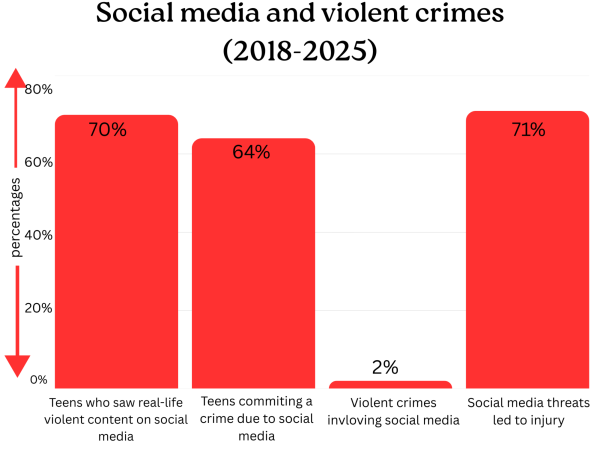
“As I scroll through social media I see a lot of hate and even threats. Following that, people under these comments can sometimes take it too far and even leak the said person’s address, doxxing them for something to possibly happen. This isn’t exactly a direct crime I don’t think but it can build up to become one if someone decides to take action with the information put out,” junior Ava Lewis said.
Even though individuals can control their own actions, the design of social media continues to amplify risky behaviors and decisions. Platforms encourage the spread of extreme content by rewarding posts with views and like that cause reactions — whether negative or positive. The idea of promised fame and attention can push people toward actions they might not consider offline. Platform design for numerous social media apps creates visuals that harmful decisions seem tempting and continuously repeated by the next user. This behavior illustrating dangerous and even criminal acts not only reveals it on a wider spectrum but aids in its growth.
From the creation of the internet, social media influences the spread and development of ideas along with crime. Platforms continue to glamorize harmful actions as well as enable it. While personal responsibility still matters in the decisions for crime, the structure and culture of these platforms enable easier crime interaction. Acknowledging the influence will aid in creating a safer online environment and reduce the growing impact of digital platforms on real world crime.


