


July 20, 1969, millions of Americans flocked to their early television sets as the U.S. completed the Apollo 11 mission. Similar to the recent Artemis II launch, which captivated a plethora of NC students, Apollo 11 marked a significant step for America and humanity as a whole. Neil Armstrong and his lunar partner Buzz Aldrin stepped onto the moon while Michael Collins, Command module pilot, orbited above. In that moment, the two astronauts and their team at the National Aeronautics and Space Administration (NASA) pushed the U.S. beyond the cusp of technological advancement. In that pivotal moment, humanity appeared to pull the unreachable extremely close to reality. Yet for a plethora of Americans, the moment felt distant and perhaps unreal.
As the grainy image of Armstrong and Aldrin appeared on millions of screens, trickles of doubt began to pour into the minds of thousands of people watching the black-and-white broadcast. Almost immediately after the airing, questions began to surface amongst the public. Widespread suspicion surrounding the waving of the flag, the Van Allen belts and other factors began to grow. Over time, these questions developed into a sophisticated allegation: the moon landing never truly occurred. Skeptics argue that various video footage perspectives, filmed on a Hollywood set, served as a means to promote global superiority in the Cold War. Approximately 50 years later, after countless instances of scientific evidence, lunar samples and further testimonies, the conspiracy remains alive. This conspiracy’s persisting popularity highlights how speedy technological advancements during a time of political crisis can feel inorganic.
“[Many are compelled to distrust the moon landing] due to the fact that most people are not familiar with how space works. I can imagine it was quite shocking at first to hear that humans had gone to the moon. Social media also has a powerful psychological influence on our beliefs. Content creators often raise questions about the Apollo landings without fully addressing the context. This, along with the fact that conspiracy theories are often never adequately challenged, the spread of misinformation and disinformation is facilitated in these closed-off online echo chambers,” Geoscience communicator and Wentworth Institute of Technology graduate Mike Brigandi said.
While the moon landing may seem swift and abrupt, it did not occur without years of political and economic maneuvering behind the scenes. In fact, the political climate of the 1960s directly determined the calculation of these technological developments. Following the aftermath of WWII, the U.S. entered the beginning of a decades-long rivalry with the Soviet Union (U.S.S.R.). After nearly ten years of increasing U.S. tensions with the U.S.S.R., the Eastern European nation began to explore a new area of discovery: the universe beyond Earth. Since the Cold War demonstrated non-confrontational acts of antagonism between the two nations, the U.S.S.R. utilized a completely new field, outer space, as a means to display power and superiority over the U.S. This competition became known as the Space Race of the 20th century. What originated as technology to develop Intercontinental Ballistic Missiles (IBMS) became the identical technology that would lead to the launch of Sputnik in 1957. Sputnik, the first artificial satellite to orbit Earth, proved that the U.S.S.R. had rapidly advanced and possessed rocket technology powerful enough to reach space. This display of technological prowess proved that the U.S.S.R. possessed the deadly capability to send IBMS to the U.S. in an identical fashion. This sticky situation created what became known as the “Sputnik crisis,” curating public anxiety within U.S. borders. In response to this, the U.S. government knew it needed to work quickly. In 1958, the U.S. created the National Aeronautics and Space Administration (NASA) and allocated government funds to science and engineering education. Motivations to swiftly reach space shifted beyond exploring the cosmos and toward advancing technologically past the U.S.S.R. U.S. President John F. Kennedy needed a public victory that would put the U.S.’ technology miles ahead of the U.S.S.R.
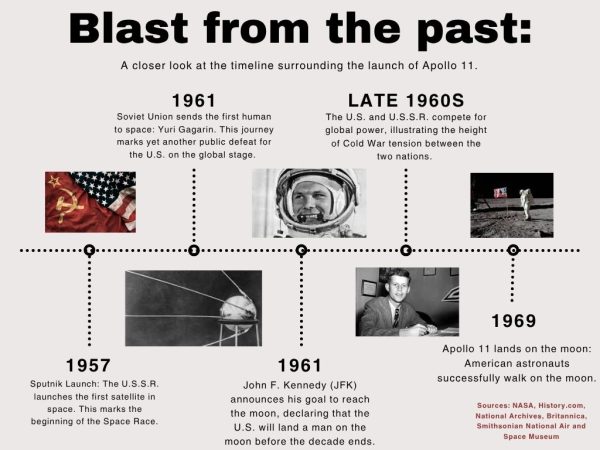
The U.S.S.R. continued to demonstrate superiority on the world stage, fueling what would later become the U.S.’s own Apollo 11 mission. Pressure increased for NASA as Kennedy declared to Congress that the U.S. needed to land a man on the moon and bring him safely back to Earth before the end of the 1960s. From this point forward, the government shifted its focus on landing on the Moon from a locational goal to an ideological, militaristic and authoritarian checkpoint. This added pressure created a time constraint that influences why conspiracy theorists continue to argue that the added layers of motive of the Apollo 11 mission function as plausible evidence to suggest that NASA faked the moon landing. Theorists debate over whether the moon landing only functioned as a Cold War demonstration of superiority, rather than just exploration out of curiosity; a U.S. failure to succeed would have created lasting detrimental effects to the country’s global force. Because of this tension, the U.S.’s pride, political world standing, and public trust all faced intense pressure. In this framework, theorists highlight the intensity of the deadline and the extreme pressure that the U.S. found itself under at the beginning of the decade. They highlight this deadline to argue that the extenuating circumstances at the beginning of the decade would have created the perfect conditions for a staged achievement. While debates continue to fester over whether these claims hold any weight, one factor of suspicion centers around the striking reality that the space race achievements reached far beyond outer space itself.
“Before knowing the facts about everything that went into the moon landing, I saw a lot of conspiracy theories on TikTok trying to prove that it wasn’t real. Some of them are pretty convincing because these conspiracists will bring up partially true things, but then twist them. And I think it’s easy to fall into that trap if you don’t go out and do your own research,” magnet junior Anyanna Ekpechi said.
Several claims appear in discussions questioning the authenticity of the Apollo 11 landing. A widely used example involves the American flag placed on the lunar surface by Armstrong. In grainy, black-and-white video footage, the flag appears to ripple and flow. Observers interpret this movement as evidence of wind or a strong atmosphere, which causes concern due to the moon’s minimal atmosphere. However, scientists involved in the mission explain that the flag’s movement occurred when the astronauts twisted the pole to secure it to the dusty, compact soil on the lunar surface. Due to the lack of air resistance on the moon, the movement of the fabric captured on camera continued because no force acted to stop it. NASA also designed the flag with a horizontal support rod located along the top of the flag so that it would stay upright in pictures.
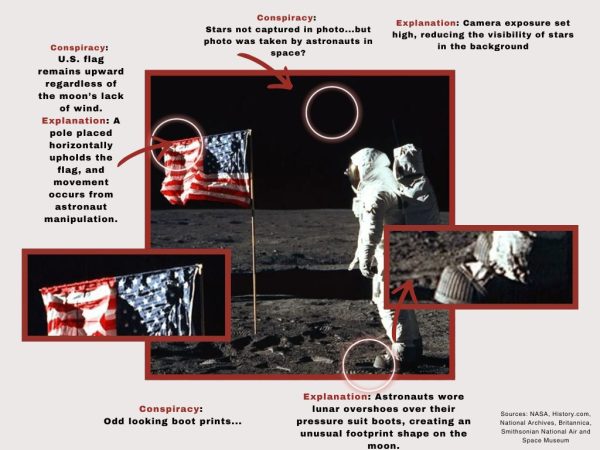
Another popular claim focuses on the photographs taken during the mission. Critics point out the absence of visible stars in the background of lunar images, arguing that if the astronauts truly landed in space, stars should appear in the background of the broadcast. However, this claim fails to account for the technical limitations of early cameras used in the 1960s. Because of the camera’s specific settings, it reasonably could not capture the stars due to the minuscule amount of light that the stars emitted compared to the sunlit moon. This effect resembles what happens when one attempts to photograph stars from Earth during the day. While stars still exist in the sky, they remain invisible to the human eye because of the overpowering light emitted by the sun. Simultaneously, conspiracists question the presence of shadows in Apollo 11 images, claiming that shadows appear inconsistent, suggesting the use of a film set or stage. In reality, these inconsistencies stem from the uneven terrain of the Moon, paired with the wide-angle lenses utilized for the mission. With these lenses, the Sun provided a singular light source, accentuating the Moon’s dips, slopes and craters and possibly distorting the astronauts’ shadow.
“At that time, the entire world was focused on the Space Race. So the ability to fake that [the moon landing] would be so near impossible, because the entire world would have to agree that we actually did land. When they [the U.S.S.R.] launched Sputnik, it emitted a radio signal that the entire world could track. That kind of made everyone look to the skies, so when the U.S. and U.S.S.R. were both racing to orbit, and land on the moon, it caused worldwide attention that would make it very hard to fake. Also, when we landed on the moon with the Apollo 11, 12, 13 (didn’t land), 14, 15, 16, 17, we left something behind each time. We have reflectors on the moon that we can point lasers at from Earth, so this is not something that would be artificial; these are man-made objects that are on the moon that we can literally put a laser on today,” astronomy teacher Chad Talley said.
Finally, the longest-standing conspiracies involve the Van Allen radiation belts. These belts consist of several zones of trapped charged particles surrounding Earth, containing high levels of radiation that would pose a risk to the Apollo mission. Conspiracists argue that passing through these belts would have posed an extreme threat to the health of the astronauts due to fatal levels of radiation and interference with the spacecraft’s electronics. However, NASA scientists carefully accounted for this risk by routing the spacecraft’s trajectory toward an area in the belts that would minimize time and exposure. By navigating through the least intense sections of radiation within the belts, the astronauts experienced low levels of radiation comparable to those of a regular X-ray scan on Earth.

Despite undeniable scientific explanations for the majority, if not all, of the theories, conspiracies surrounding the moon landing persist. The question then shifts from whether it happened to why a plethora of people continue to doubt it. The context surrounding the time period of the moon landing explains why individuals still doubt the Apollo 11 mission, regardless of scientific evidence that contradicts each theory. Scientific evidence and research by advanced services like NASA help to disprove these suspicions and reinforce the legitimacy of the mission. Ultimately, while external social and political pressure may explain doubtful questions about the landing, those conditions fail to outweigh the overwhelming scientific, photographic, contextual, empirical, tangible and observable evidence that confirms the success of Apollo 11.