



Each day, students and adults alike wander through their lives, passing others in need without batting an eye. The bystander effect describes a psychological pattern where individuals hesitate to act when others linger. Responsibility spreads across a crowd, causing personal accountability to shrink. Instead of stepping forward, people pause, observe and assume another person will respond. This concept originated from social psychology research during the late twentieth century, and the effect’s relevance stretches far beyond human emergencies. Environmental issues showcase one of the clearest modern examples of the bystander effect in action.
Environmental choices trigger the bystander effect through scale and distance. Climate change, pollution, habitat loss and species decline feel global, complex and overwhelming. When students hear crazy statistics such as 2024 proved 0.18 degrees hotter than 2023 or that 2025 appeared as the fifth consecutive year that the ocean heat content hit a record high, a disconnect forms. Individual actions seem insignificant next to international industries, government policies and billion-dollar corporations because of the overwhelming disparity in scale, power and structural influence. That mental gap encourages passivity, which then leads to further decline in the status of the world’s health. Recycling one bottle, reducing meat consumption or conserving water feels pointless when factories release thousands of tons of carbon dioxide daily. This mindset pushes people into observer mode instead of participant mode, strengthening environmental inaction.
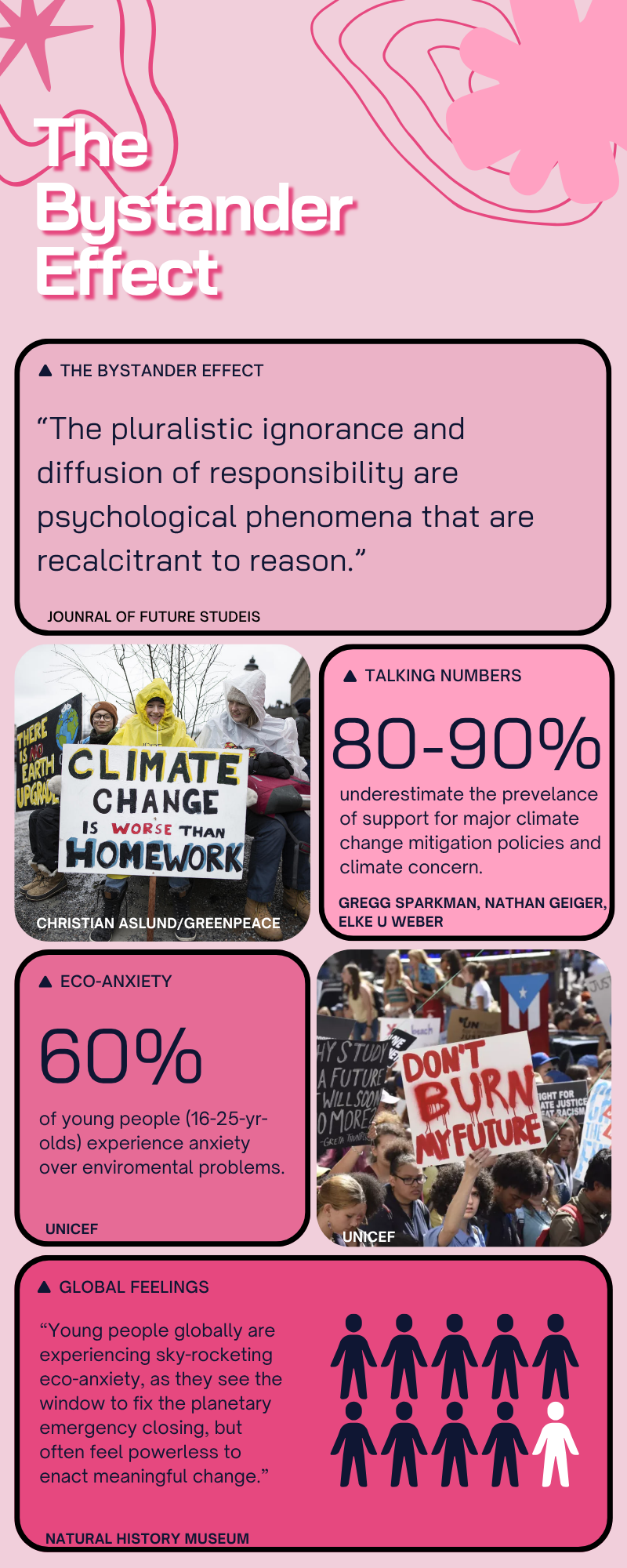
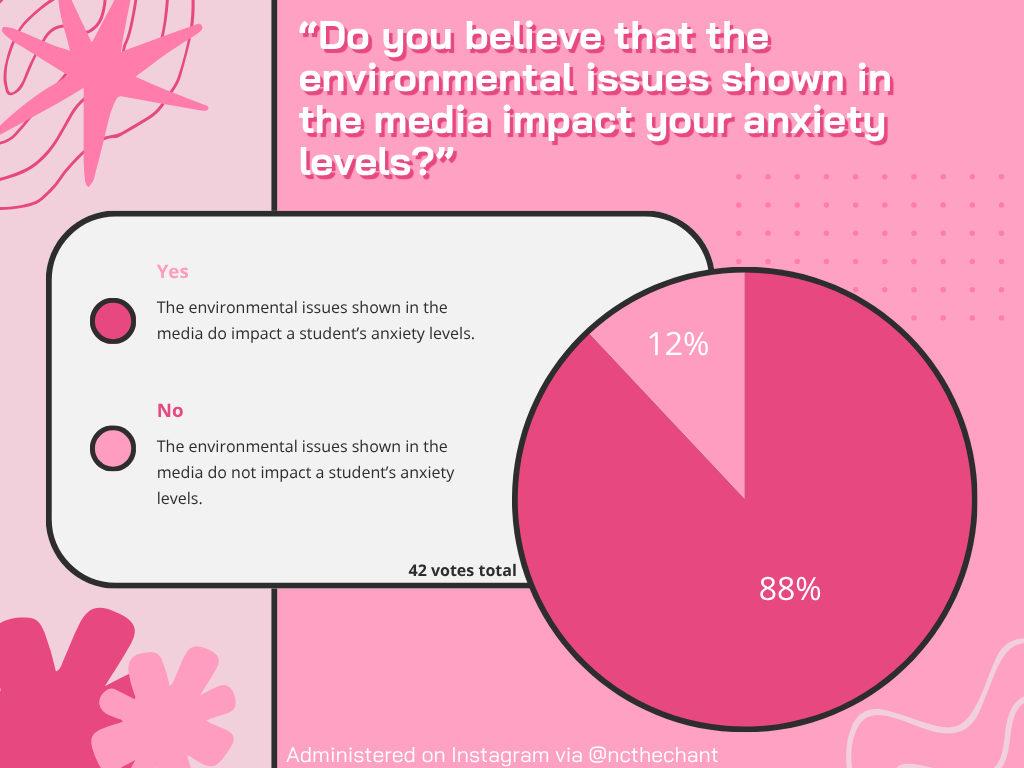
Media coverage contributes to this response. News outlets and social platforms share constant updates about melting ice caps, record-breaking heat and mass extinction events. According to the American Psychological Association, over 60% of teenagers report feeling anxious or powerless after learning about climate change. Instead of motivating behavioral change, repeated exposure without clear steps for action fuels emotional burnout. The bystander effect feeds on that burnout, convincing individuals that concern alone counts as effort.
“It’s so much easier, right? To post about something other than to go to a cleanup or even to know about where the opportunities are to be engaged can be hard. And so I think that is [only posting about an event rather than going] something that can happen. I don’t want to discount even the level of awareness that can come from [social media], though. I don’t want to suggest that that’s not useful, but there is a difference between commenting or posting on something and then participating in some substantive effort to change the conditions that made it. So, I think there can be that dynamic, but at the same time, one of the things that I get to do is work a lot with communities all around the South and the U.S. Islands who are very much building a community around addressing environmental issues, and so I think it kind of depends a little bit on the person, situation and the availability of opportunities in their area,” William D. Bryan, Ph.D. Director of Research with the Southeast Energy Efficiency Alliance (SEEA) said.
Plastic pollution provides one strong example of the environmental bystander effect. Research from the United Nations Environment Program estimates that over 430 million metric tons of plastic enter production each year, with roughly 36% used for single-use packaging. Even though one plastic bottle takes up to 450 years to decompose, people still rely on disposables because responsibility feels shared across billions of consumers. Surveys show that 74% of Americans express concern about plastic pollution, but in part due to the responsibility’s bandwidth. Only 30% consistently avoid single-use plastics. Concern exists, action stalls, and the bystander effect bridges that gap. This same disconnect between awareness and action echoes beyond plastic, shaping other environmental crises driven by collective habits.
Carbon emissions present another clear case of the bystander effect. The Global Carbon Project reports that human activity releases over 36 billion metric tons of carbon dioxide annually. Transportation alone contributes to nearly 29% of total greenhouse gas emissions within the U.S. Despite the high transportation emissions, rates of individual resistance remain low. Even though numerous drivers acknowledge climate change, their personal driving habits remain unchanged. Thoughts like “one car changes nothing” overpower scientific reality because when millions of drivers think that way, collective impact multiplies. The bystander effect thrives on underestimating cumulative behavior. Recognizing this pattern reveals that change depends on disrupting the mindset, not just understanding the data.
Environmental psychology research shows that visible action disrupts the bystander effect. When individuals witness peers using reusable bottles (even for fads such as the Stanley and Owala trends), participating in clean-ups or advocating for policy change, engagement rises. A 2021 study published in Nature Climate Change found that individuals exposed to climate-positive behaviors within social groups increased sustainable choices by nearly 40%. Together, these examples show that shifting visible behavior holds the power to break the cycle that both plastic use and carbon emissions continue to follow.
Common misconceptions strongly influence environmental choices, and a substantial number of individuals support environmental protection in theory, yet incorrect assumptions weaken meaningful action. These beliefs create distance between concern and behavior and reinforce the bystander effect. Misconceptions strengthen the mindset that because everyone shares responsibility, individual decisions carry minimal impact.
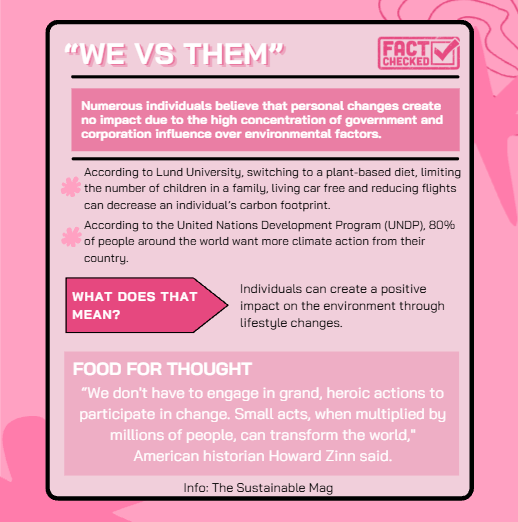
A common incorrect assumption centers on the belief that individual actions hold no influence compared with those of corporations or governments. Industrial activity certainly contributes heavily to environmental damage; however, consumer demand directly shapes production patterns. Research from the International Energy Agency shows that household consumption accounts for roughly 60% of global greenhouse gas emissions through transportation, food and energy usage. Adding to consumption’s importance, each purchase signals demand within the marketplace. For example, dietary shifts illustrate this connection clearly. Livestock agriculture contributes to about 14.5% of global greenhouse gas emissions according to the Food and Agriculture Organization, and when individuals reduce meat consumption even slightly, demand shifts within supply chains. Grocery stores expand plant-based options, restaurants adjust menus and agricultural investment changes direction.
“Many issues, such as climate change and plastic pollution, seem so large that people often feel their individual actions cannot make a difference. For example, if someone stops using plastic straws, they may not feel like they are making a significant impact because there is no immediate or direct change to be observed. Recycling is nice in theory, but it doesn’t cover all facets, and we see similar effects with other fixes individually, but when the changes work in tandem, that’s when we really see change. By collectively adopting sustainable habits, such as reducing waste and voting for greener policies, small actions scale up to drive significant, visible change. Ultimately, these combined efforts transform personal habits into powerful environmental movements that can influence both public awareness and corporate accountability,” Advanced Placement (AP) Environmental Science teacher Julie Hopp said.
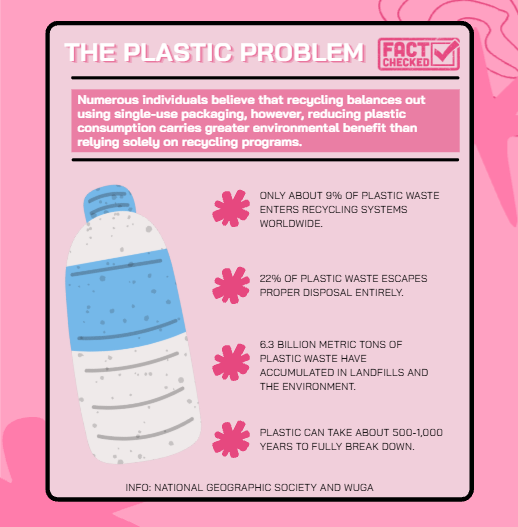
Another fallacy focuses on recycling as a complete solution for plastic waste. Recycling helps reduce landfill pressure, yet global recycling systems capture only a fraction of plastic materials. According to the Organization for Economic Co-operation and Development, only about 9% of plastic waste enters recycling systems worldwide, and roughly 22% of plastic waste escapes proper disposal entirely, entering rivers, oceans or natural landscapes. Due to the heavy promotion for recycling, roughly 77% of Earth-lovers assume disposable packaging carries minimal environmental impact. That belief encourages continued reliance on single-use plastics, when, in reality, reducing plastic consumption carries greater environmental benefit than relying solely on recycling programs. Reusable containers, water bottles and cloth shopping bags (no, not the plastic ones from Publix) prevent waste from entering the system in the first place.
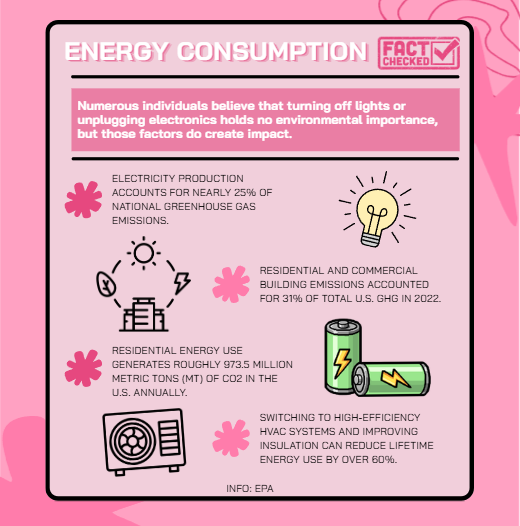
Energy consumption also reveals another misunderstanding: households assume that turning off lights or unplugging electronics holds no environmental importance. Electricity generation within the U.S. still depends heavily on fossil fuels, and, according to the U.S. Energy Information Administration, electricity production accounts for nearly 25% of national greenhouse gas emissions. Focused conservation habits accumulate across millions of homes, and if each household reduces electricity usage through efficient lighting, appliance management and energy-conscious routines, national energy demand declines significantly. Minor behavioral shifts across major populations produce measurable environmental outcomes.
Failing to respond to these misconceptions reflects the bystander effect in environmental decision-making. Individuals notice pollution, climate change and ecosystem decline, yet incorrect beliefs reduce urgency, and others — corporations, governments, activists or scientists — appear responsible for solving the issue. Personal responsibility fades into the background. This psychological distance allows environmental damage to continue while individuals remain passive observers.
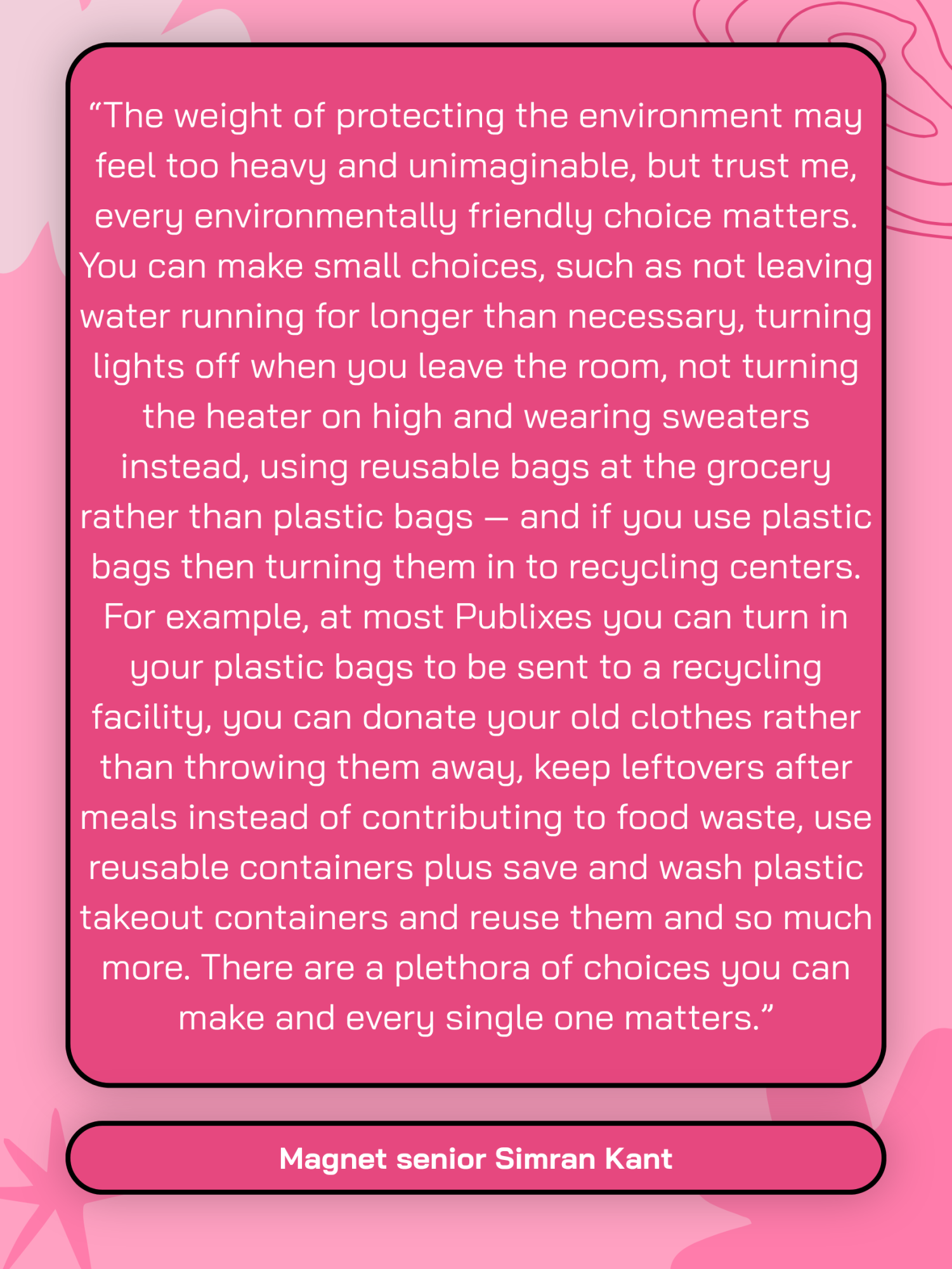
High schools hold a strong influence over student behavior, which means school communities carry real potential to reduce the environmental bystander effect. When environmental responsibility fades into the background, students may assume another group — administrators, environmental clubs or future policy makers — will handle the issue, but that mindset reflects the bystander effect. Action within a school environment can shift that pattern by showing that everyday choices inside classrooms, hallways, and cafeterias connect directly to environmental outcomes. At NC, clubs like EcoWarriors help to promote a healthy learning environment through beautification initiatives, even earning NC’s status as a “Green” school. Even though initiatives like NC’s recycling plan helps to reduce trash around campus, students still turn a blind eye to garbage outside of designated spots and assume that janitors or teachers will take the time to clean up. This flawed notion flows throughout adulthood, but it sprouts from childhood and grows perilous from there.
“Due to EcoWarriors, we were able to get NC to become a part of the Green School Society last year. We can all make a difference, no matter how big or how small — every choice matters. EcoWarriors holds campus clean-ups every few months, where we clean all of the spots around campus that often get overlooked, such as underneath the football and softball stands. It’s insane how much trash can get caught in these places and alarming how many animals are impacted by it. An effective way to also help the school go green is helping out with the recycling initiative. I encourage peers to put old papers in the recycling bins instead of the trash can and try their best not to put trash in the recycling bin, as even one singular candy wrapper can lead to that entire bin of paper being discarded as waste. In class, students can choose to only use their laptops when they need to and not leave [them] on or running for excessive periods of time to save energy. People can also consider carpooling with their friends to school or riding the bus to reduce carbon footprints,” magnet senior Simran Kant said.
One effective change involves visible sustainability programs throughout the campus. Recycling stations alone rarely shift behavior if students lack clear direction. Signs explaining what materials enter each bin, combined with short classroom lessons about waste management, strengthen participation. According to the Environmental Protection Agency (EPA), the U.S. produces over 292 million tons of municipal solid waste each year, and paper products account for roughly 23% of that waste stream. Schools rely heavily on paper through worksheets, handouts and printed assignments. Digital submission systems reduce unnecessary printing while saving resources. Even simple steps — double-sided printing policies or digital class notes — reduce waste within a school setting.
Change does not begin with distant leaders or future policies; it begins within daily choices that feel insignificant in isolation yet powerful in combination. The bystander effect loses strength when responsibility shifts from “someone else” to “me, right now.” Every reusable bottle carried, every piece of plastic refused, every light switched off and every conversation started about sustainability chips away at the culture of inaction. When students, communities and individuals step out of observer mode, momentum builds and spreads. Environmental decline continues under silence, but collective, consistent action rewrites that trajectory. The question no longer centers on who will act — it centers on who chooses to stop watching and start participating.
“It [environmental issues] may not come to the surface as one of the key issues that you’re concerned about if you’re not living in an area where you experience them in a visible and obvious way every day. So, communities that live near a landfill, for instance, are more likely to speak out about certain things because they live with the consequences of those policy choices day to day. It’s not something that becomes invisible, whereas I think for others, it can more easily be compartmentalized. So, yeah, I think for sure social pressure can play kind of a key role in [a person’s willingness to acknowledge environmental issues],” Bryan said.