


The title “half-man half-woman makes self pregnant” ensures viewership through sensationalism; however, it hides the true situation behind the crime. While the tabloid era of news has ended, a new generation of crime reporting has entered the spotlight: true crime. With viewers consuming this content to quench their thirst for curiosity, the wording of events acts as a witness to the truth behind the screen. Each word in criminal news carries not only emotional and legal weight but also the reputation and perception of every individual’s story.
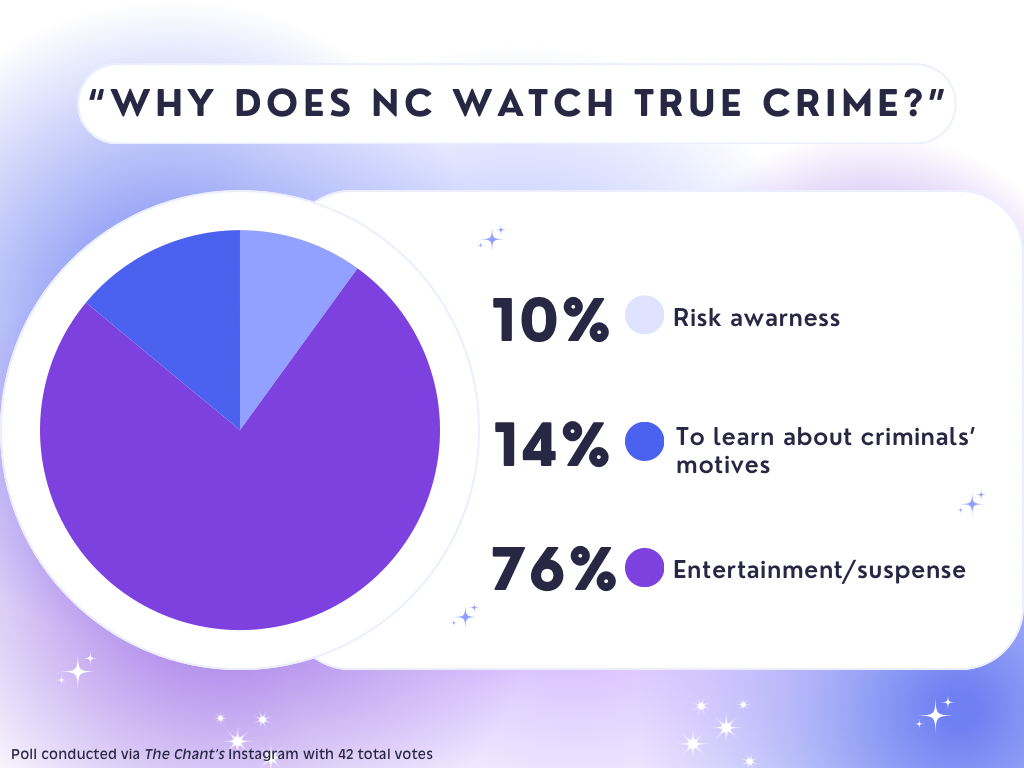
Docuseries, documentaries and true crime influencers base their content on journalistic reports, with 84% of U.S. adults in 2024 consuming true crime media and 37% preferring to read their news. Shows such as “Criminal Minds” further popularized forensic psychology by focusing on internal motives and the “why” behind crimes, influencing viewers to assume the role of a forensic psychologist. Women — who comprise 76% of Criminal Minds’ audience — experience 2.5 times the likelihood compared to men to watch true crime for risk awareness. Despite this fact, preparation falls short of the main reason for crime content consumption, with 73% of viewers consuming media out of curiosity and 46% of viewers watching for entertainment. According to a poll conducted on The Chant’s Instagram, 76% of NC students mainly enjoy watching true crime for suspense, not focusing on discerning the connotations of semantic rhetoric. This consumption of content acts as a gateway into the world of journalistic reports. As a result, the blurred line between sensationalized crime media and factual reporting creates a dilemma, especially when viewers substitute true crime consumption for news research.
With audiences consuming true crime out of curiosity, viewers feel called to research real reports on the case. The linguistic framing in these crime articles influences how audiences assign blame, empathy and moral judgement, especially after sensationalized crime media sets their perceptions. The primacy effect and the first impression bias posit that people remember the information they first view, which shapes their long-lasting impression or understanding of society. Hollywood will write narratives based on what audiences presumably remember from infamous cases to ensure views and maximize profit. Through the consumption of crime media, viewers subconsciously elucidate events through top-down processing. Viewers will first interpret the broader picture with their existing knowledge — such as facts from sensationalized shows — and then focus on details. Audiences may start by simply watching a documentary or docuseries before trying to fill in the informational gaps about the case through researching journalistic reports.
“Reporters are often focused on being the first to cover a story, which can lead readers to fill in the gaps or make theories where information from authorities is limited. People remember what they see first, because when a case is initially publicized, it gets the most attention. By the time facts have been clarified, the ‘buzz’ has died down. As a result, many true crime narratives are built on early reports, which is what people often remember. For example, in cases like Gypsy Rose, many people only remember the facts presented in the show and make their own theories rather than acknowledging the full reality of the case,” magnet sophomore Jay Singh said.
The prioritization of speed in breaking news reporting results in the spread of misinformation and information gaps. Due to verification issues, stations purposefully publicize vague information — the skeletal facts — to maintain the case’s accuracy. This limited information leaves curious viewers to infer events and create conspiracy theories. For example, in the case of the 2017 Mandalay Bay Shooting, news channels reported gunfire, and people heard shots in the released footage. The adjacent glass buildings echoed the shots and caused the video to sound like the gunfire originated from the surrounding Las Vegas Hotels, prompting the “second shooter theory.” This misconception caused the public to believe another gunman shot the concertgoers. By the time authorities disproved the conspiracy, the buzz had died down and society shifted to the next shocking event.
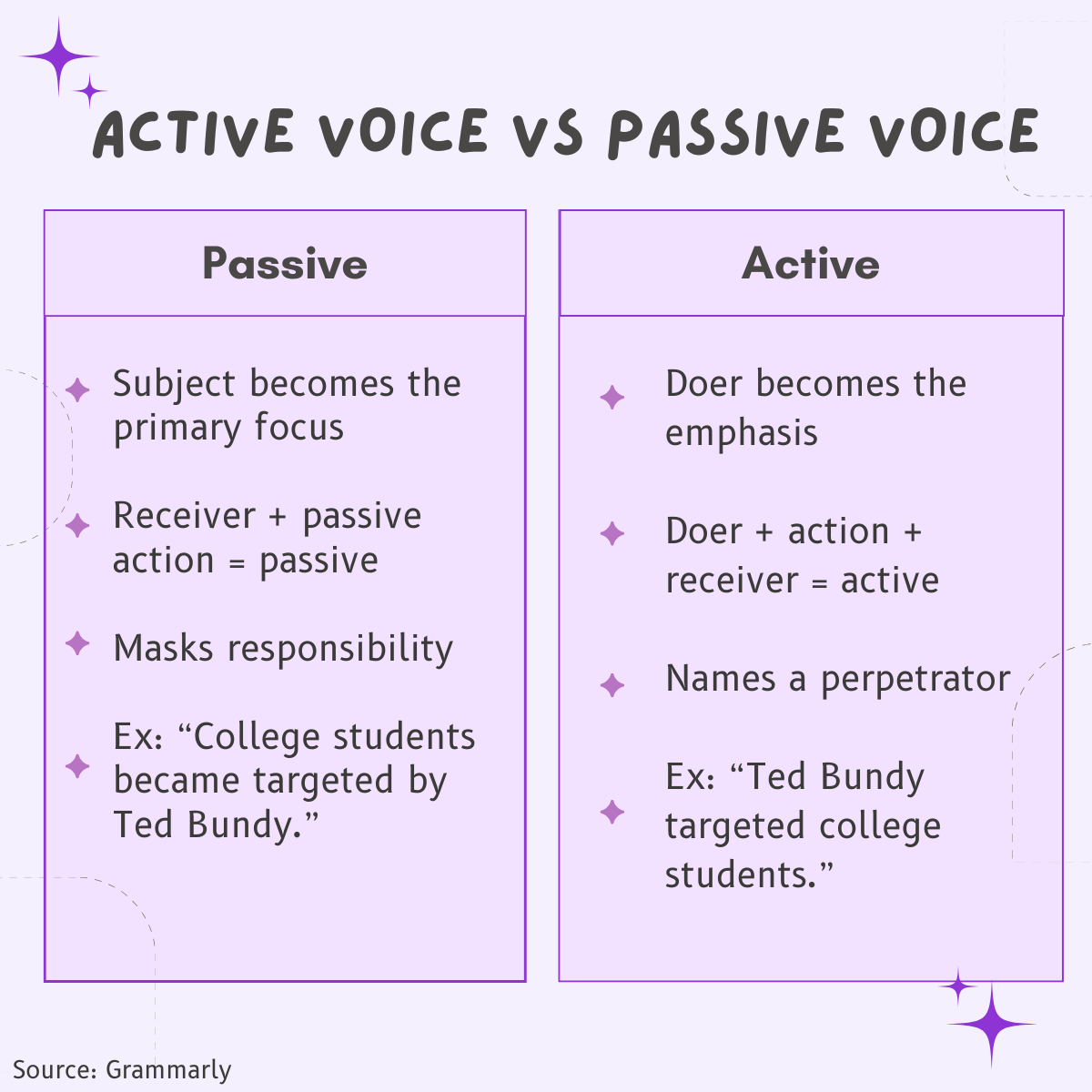
Flagrant dehumanizing labels such as “convict,” “thug” or “illegal alien” further shift the focus away from victims and perpetuate negative stereotypes. Even commonly overlooked epithets such as “the mentally ill” or “the homeless” pose an issue and stigmatize the already marginalized populations. This terminology influences public perception, separates the individual from a community and hinders reintegration into society. Furthermore, the misuse of passive voice emphasizes the victim over the perpetrator; while the tense maintains neutrality, it also reduces accountability and, instead, unintentionally places blame on the victim. For example, in the sentence “a woman was killed,” the wording emphasizes the victim. By providing a subject — “a man killed a woman” — the focus shifts to how an offender’s violent actions affected an actual human, not another mere statistic.
“The choice of words, especially in the coverage of crimes, can intentionally or unintentionally influence how consumers think about the people involved in the criminal case. For example, mentioning a suspect’s past criminal activities and any association that they may have with ‘shady’ people can give the audience the impression that they are guilty of something,” Ohio State University Associate Professor of Communication Felecia Ross said.
In situations where reporters need to quickly and accurately provide information, passive voice confirms details without potentially spreading misinformation, but may also show bias and lead to dropped cases. Active voice presents itself as a standard of the professional press — even in high school articles like The Chant — with reporters conventionally finding passive voice unfavorable. Even so, news channels may resort to the recipient-focused tense to prioritize promptness or sole details, especially when recounting local indictable crimes. Passive voice becomes useful or occasionally necessary when a criminal remains unknown; a reporter needs to maintain anonymity and when the act itself arises as the primary concern of a case. While not always feasible due to limited confirmed facts, particularly in breaking news reports, a majority of journalists aim to maintain a finite balance between grammatical voices by applying the active voice when possible. Nonetheless, yet another a new type of reporting — without set standards — has exploded over the last decade: social media journalism.
While news channels may choose to censor information or limit intel, independent content creators can report on events in an opinionated manner and provide context understandable to their demographics’ schemas. Yet even on social media, certain creators censor true crime content to avoid video removal or demonetization. Creators, to garner traction, may use sensationalist clickbait titles. These occasionally cause a resurgence in a case months or years after its relevance, and internet armchair psychologists tend to produce theories based on what they believe happened. Creators may also provide follow-up stories that include these conspiracies and involve backstories that televised news deems unnecessary in content. With internet sleuths assuming the role of a criminal psychologist, these specious descriptions enable viewers to use tragic backstories or unfortunate childhoods to excuse offenses rather than to explain criminal motives. For example, after watching the popularized show based on the Gypsy Rose Blanchard case, netizens defended Gypsy Rose killing her mother based on childhood abuse. In addition to online users rationalizing criminal behavior, algospeak — such as “graped” or “unalived” — continues to mask responsibility and downplay the severity of cases by desensitizing viewers.
“Using euphemisms could undermine the severity of the case. I think a lot of people, myself included, enjoy true crime, but sometimes forget that this is actually a person and a victim. I think word choice matters because you want to make sure that you’re reporting and raising awareness about the case, but you have to be professional. You want to make sure that the victim’s family is also protected, but using passive voice displaces the blame. While you do want to raise awareness, you’re really making it about victims, but still not crediting the killer,” magnet literature teacher Laura Smith said.
Gendered language further underemphasizes the gravity of crimes. This terminology perpetuates harmful stereotypes, particularly against women and minorities. Euphemistic expressions such as “marital dispute” mask the violence of domestic violence crimes. On the other hand, sensationalist titles like “mother of two” place emphasis on women’s roles, which sways how society perceives the defendant. The epithets evoke reactions from the community, instead of presenting neutral facts of potentially abusive situations, which removes the focus from the victims’ perpetrators.
Audiences maintain the psychological need to know the “why” behind a crime, which compels viewers to generally focus on perpetrators’ motives. Oversimplified breaking news reporting lacks sufficient context by only providing the “now.” The lives of victims may fall into the background as mere implications. Crime reports focus on details that matter during the breaking news period; they progress into depth after the initial shock of the crime has died down, with comprehensive documentaries as the “second act.” Although a majority consume true-crime content for entertainment, viewing true crime and simply storytelling leads to emotional detachment and the normalization of violence. Especially in regard to local news, these effects may result in individuals not exercising caution. Consuming news from multiple sources will help mitigate political affiliation biases.
The media operates similarly to a business, leading to the prioritization of profit rather than accuracy and neutrality. With the news playing a role in the public agenda, the narrative social media and traditional outlets uphold influence, accountability and surveillance. Certain NC seniors already maintain the eligibility to vote, which remains a civic duty to understand the current sociopolitical world, ultimately becoming paramount to all of society. While not all students participate in elections, acknowledging the power of words remains a crucial life skill that teenagers need to develop before entering adulthood. Media literacy underwent a decline after COVID-19, resulting in society — both adolescents and adults — becoming susceptible to implicit messaging. The skill starts developing before one even learns how to read. The continuous process begins with these foundational critical thinking skills and progresses into analyzing bias and messages in the media. These semantics influence how audiences perceive people, and therefore, future history as society and fellow NC students will know it.