


At NC, talented artists sparkle throughout the campus. Students can find paintings, ceramics and sculptures proudly on display and raw with emotion, creativity and storytelling. Throughout history, art has played a major role within cultures and societies, inspiring and impacting the livelihoods of generations upon generations of people. Art not only exists as a tool for entertainment, but it also expresses communication and historical documentation.
“It’s safe to say I’ve been doing art for around 10 years. The key component that made me want to do more of it was that it always gave me an escape. It has always been a safe space for me to go and express my emotions. I’d make something of them and feel relieved, like a burden was lifted off my back. I’ve always gotten inspiration from those around me, whether it’s the music I’m listening to or an event that has happened in my life, literally so much. It is extremely emotionally-driven for me, and over the years, it has been a part of me,” sophomore Pilar Silvera said.
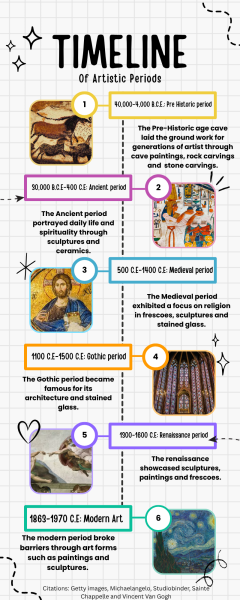
For as long as people walked the Earth, art has evolved with them. The first documented instance of art took place within the Paleolithic era and the Old Stone Age. Contrary to popular belief, the first painting did not reside in a cave, but instead resided on a 73,000-year old-rock found in modern-day South Africa. Although the first paintings, such as the Apollo 11 stones, dwell on rocks and ochres, cave paintings exist as the main place to observe prehistoric art. The caves themselves preserved the drawings from natural elements, which aided historians later on in studying past civilizations.
Art portrayed cultural rituals while also capturing the environment and landscape. Illustrations during the prehistoric period served as a way to communicate and document before a written language existed. Apart from paintings, sculptures, and engravings commonly came from natural materials in prehistoric art. Early Mediterranean cultures utilized sculpture and engraving heavily in art pieces. Within their works, these cultures commonly used ceramic pots to showcase scenes of daily life, such as the baking of bread and the production of metal.
In addition to Mediterranean art, sculptures during the Cycladic period depicted the important role of music within societies. Artists rarely depicted males in sculptures. On the rare occasion that men did appear in art, they played instruments, showcasing their role in society as musicians. In early civilizations, musicians not only provided entertainment, but they also served as storytellers, sharing folktales and myths throughout their communities. To add to musicians’ relation to art, ancient Greek artists commonly erected statues of accomplished musicians, furthering the connection between visual art and music within the ancient period.
From 30,000 B.C.E. to 400 C.E., ancient art commenced. The ancient art movement, set off by the quick advancements of civilization and written language, emerged in Mesopotamia, Egypt, Greece, Sumeria, Akkadia, Mexico, Rome, Japan, China and India. Along with the creation of written language, organized religion and ideological social hierarchies, storytelling started to become a strong driving force in the creation of art. For example, in ancient Egypt, creatives used prominent symbolic imagery alongside text, also known as Hieroglyphics, telling the stories of rulers, gods and goddesses.
Egyptian rulers’ tombs also included elaborately painted images with symbolism alluding to the scenes that portrayed the deceased’s spiritual journey to the afterlife. In particular, Anubis, the god of death worshiped by ancient Egyptians, appeared on multiple tombs as a way to invoke the powers of the god to aid in preserving the deceased bodies, along with protecting the dead. Mesopotamia, also known as the “Cradle of Civilization,” housed a famous work from the period known as the “Code of Hammurabi.” This piece of art depicts a set of laws carved into stone, which accompanies an illustration of King Hammurabi and the Mesopotamian god Shabash.
The Middle Ages followed the fall of the Roman Empire, causing mass political fragmentation along with economic strife. Simultaneously, the Middle Ages saw the rise of Christian art because the early Christian church placed extensive funding into seeking valuable material for religious art. During this time, the Catholic Church sought out valuable goods such as gold and ivory to incorporate into art pieces. Stained glass depicted various notable points within the Bible, and sculptures in the entryways to places of worship greeted religious followers with images of Jesus Christ in various points of his life. Utilizing visual depictions throughout places of worship helped Christians with no access to scripture or literacy understand their religion. Even with the growth of literacy rates throughout the world, churches still utilize visual storytelling through art.
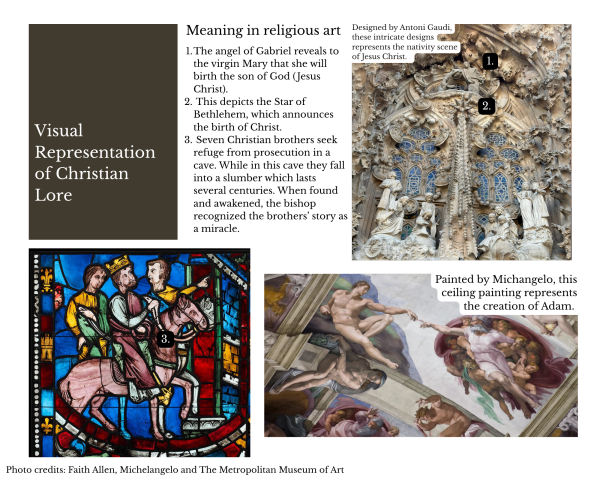
The Renaissance, a particularly prolific movement of the Late Middle Ages, invited the revival of art in addition to the classical age throughout the 14th to 17th centuries. Within this timeframe, artists in Europe introduced various advancements in techniques and materials utilized in artistic creation. Ordinary people and common lives became a prevalent subject in paintings during this time, in addition to scenes of battle and religious figures. The Renaissance also cultivated various famous artists and pieces. Sandro Botticelli and his painting, “The Birth of Venus,” as the title suggests, depicts the birth of the goddess of love. The Sistine Chapel, located in the Vatican City, hosts significant works of art on its ceiling. Frescoed by Michelangelo as a commission for Pope Julius II, the numerous ceiling paintings portray various stories from Christian lore, such as “The Creation of Adam” and Noah’s ark, showcased in “The Deluge”.
The notable Gothic movement occurred simultaneously with the Medieval movements. The word Gothic, coined by Italian writers of the Renaissance, acted as a derogatory term toward the perceived “ugliness” of the architecture of the Gothic tribes. Well known for the distinctive architecture produced, the Gothic period of art also consisted of sculpture and paintings full of character and movement. A uniqueness in the Gothic period exists through the regional variations existing in art and architecture in Europe. For example, Flamboyant Gothic, which spanned from the 14th to the 16th century in France and Spain, received its name from the dominant usage of flame-like, intricate designs. The Church of Saint-Maclou, located in Rouen, France, acts as a famous example of flamboyant Gothic and incorporates numerous elements from the Norman tradition of Viking settlers of northern France through their lantern towers.
Similar to medieval art, Gothic art held a religious focus. In the Gothic period, there existed a heavy desire to construct and depict art that conveyed heaven on Earth. The “Shrine of the Three Kings,” located in the Cologne Cathedral in Germany, exceptionally exemplifies this goal within Gothic art. The shrine allegedly serves as the place of rest for the three wise men. First found by Helena, mother of Constantine, the shrine traveled from Constantinople, then transferred to Milan under the bishop Eustorgius, in 314 C.E., and finally it reached Cologne, Germany, where the sculpture has remained for centuries.
The Baroque period occurred from 1600-1750 B.C.E. Characterized by the revival of religious worship, the movement relied heavily upon drama and theatrics. During this period, artists depended strongly upon the usage of light to create tension, movement or intense emotion. By using certain techniques in order to depict mythical entities and people, artists could convey messages to engage the emotions of the viewers. Architecture similarly portrayed dramatic dynamics through breaking the rules of classical art that preceded the era. Inside buildings, rooms fabricated the illusion of openness toward the sky and hidden windows provided illumination to altars, domes and religious art, additionally adding aspects of theatrics into biblical storytelling.
Throughout the 19th and 20th centuries, the creation of cameras completely changed the way artists approached visual storytelling. The usage of narratives through photos and film provided an alternative approach to documenting and immortalizing historical events and life. As a result, visual art became increasingly experimental. Artists no longer felt expected to represent events or people in the literal sense and newer art movements started to focus on emotions, abstract concepts and impactful messages. In expressionsm, artists sought to convey emotion rather than physical reality. For example, “The Scream,” painted by Edvard Munch, depicts an exaggerated portrait of a screaming man. The lines and brush strokes of this painting, though not realistic, amplify the feelings of dread and anxiety seen within the painting.
Dadaism saw the emergence of avant-garde styles, the political destruction of artistic norms and the power structures of society. “The Fountain,” a sculpture of a urinal created by Marcel Duchamp, sparked controversy amongst artists and intellectuals about the qualification of the piece as real art. Later on, the piece became the defining work of this period. Pablo Picasso, a famous artist during the Cubism movement, captured and documented the feelings of destruction, dread and devastation during the German bombing of the Spanish town of Gurenica in a painting entitled “Gurenica.” Unlike earlier periods, Pablo expressed the tragedy of Guernica through abstract figures, so that viewers could create their own interpretation of the event. Art transitioned to focus on individual feelings and the personal release of creative restraints from previous movements.
“Art allows me to express my soul and create whatever I want. I get to create my own characters and show them how I want them to appear. I feel like a great art piece, painting, or anything can really tell a story. Like Vincent Van Gogh, he shows a lot of emotion, and I think that tells the story itself, you don’t necessarily always need words to say them,” sophomore Elly Buzzar said.
The latest movement of today’s society, contemporary art, has brought in additional innovation and creativity to art. The contemporary movement tackles the complicated and nuanced topics of current times, such as identity, race, current events and politics. A majority of young artists want to express meaning through everyday objects and materials instead of tangible plots, characters and settings. The contemporary movement also extended the boundaries of visual storytelling by including live performances, videos and installations, successfully breaking tight boundaries set by previous creatives.
“In my opinion, the connection between storytelling and art goes hand in hand, and the impacts are limitless. I think there is purpose in art, and I also think it truly depends on someone’s perspective on how they will answer that question. How does one define purpose? Is it interpersonal, or should the ‘purpose’ have a larger scale meaning, such as the current state of the world, politics, etc.? Every day I see artists using their talents in meaningful ways, and their artwork inspires me to continue creating,” Contemporary Artist Christian McKenny said.
Art illustrates the human experience by exposing various cultures and historical events throughout the world. Through visual pieces, artists create meaningful dialogue between members of society about serious topics, from the dissemination of religion to the problems in a nation. Through human accomplishments, troubling times and positive periods in history, artists continue to depict these events with the hope that the world could gain a deeper respect for the individual perspectives of the masses around them. Through a broader understanding of other people, effective change can occur throughout the world.