


January 7, 2026, a 37-year-old Minneapolis resident, Renee Good, faced an encounter with Immigration and Customs Enforcement (ICE) agent Jonathan Ross during a federal operation, which resulted in the officer shooting her to death. The incident remains under investigation, but has prompted major responses throughout the state, increasing tensions between state officials and the federal government. Minnesota residents felt this shooting represented a turning point in Minnesota’s ongoing debate over federal immigration enforcement and since numerous citizens gathered in remembrance of Good and showed their real opinions on this situation.
Post-incident federal officials stated that the ICE agent involved in Good’s death pulled out his weapon after perceiving a threat during an enforcement action. Local leaders and community members responded by questioning this account as publicly released video footage of the shooting surged throughout the media and new sources. Disagreements about what actually happened in the shooting led to numerous individuals closely examining how ICE conducts its enforcement operations in Minnesota, shaping public reactions to ICE cases.
“I saw the video on TikTok, and it took over my whole For You page. I started looking into the shooting and kept updated on the women and the agent. I have seen the protests going on and now the lawsuits going against Minnesota leaders for protecting their people. The amount of violence going on is truly crazy,” magnet senior Avery Moore said.
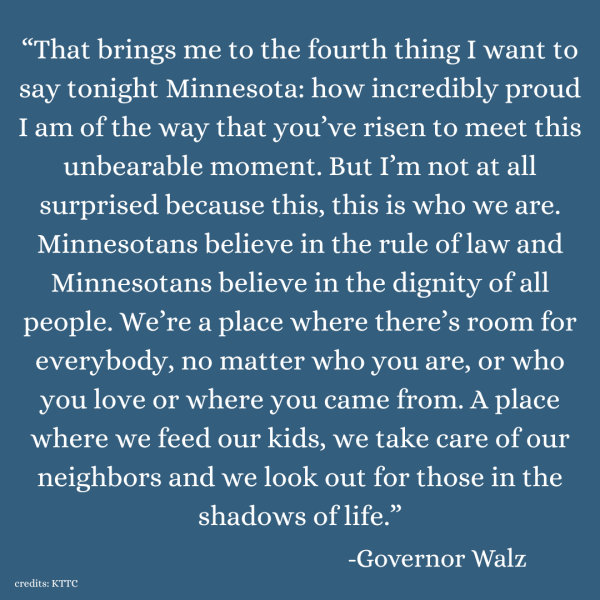
Following the released video footage and disagreements, Minnesota Governor Tim Walz and Minnesota Mayor Jacob Frey publicly criticized the federal government’s handling of the situation and argued that the agent’s gun-firing decision created unnecessary danger. Mayor Frey stated that the video evidence did not clearly support what the federal government initially described the situation as. State officials emphasized that the federal government failed to consult with Minnesota officials before the operation and reiterated their disagreements with ICE and the federation.
The public quickly reacted to this event in hopes of standing up for Good. Protests and vigils emerged throughout Minneapolis and other Minnesota cities, with thousands of concerned citizens in attendance. Protestors called for increased accountability, policy changes and limits on ICE operations within the state. These protests remained peaceful, but the presence of federal agents overall led to higher tensions between protestors and law enforcement.
Legal developments also quickly followed as Minnesota, along with cities Minneapolis and St. Paul, filed lawsuits hoping to limit or halt aspects of ICE. In these lawsuits, the state argued that ICE searches and violence violated constitutional protections and state sovereignty. The federal officials rejected these claims, stating that immigration enforcement falls under federal jurisdiction and remains protected by the Supremacy Clause of the U.S. Constitution. The U.S. Department of Justice also declined to open a federal civil rights investigation regarding the shooting, which resulted in strong amounts of criticism from state leaders, as they believed the federal government lacked care for the people.
This legal conflict worsened when federal prosecutors issued subpoenas to numerous Minnesota officials, including Governor Walz and Mayor Frey, as part of a criminal grand jury investigation examining whether state leaders interfered with federal enforcement efforts. State officials denied any wrongdoing and described the subpoenas as politically motivated. Court rulings also played a significant role in recent developments. A federal judge initially restricted ICE agents from arresting or using force against peaceful protestors, but an appeals court later lifted those limits, which allows broader enforcement actions to resume.
This conflict in Minnesota gained the attention of national political leaders, who contributed to this debate. President Donald Trump defended ICE agents and characterized the shooting as a tragic outcome of dangerous conditions faced by federal officers and stated he regretted the loss of a life. His words resulted in mixed reactions, with supporters showing an emphasis on law enforcement safety and critics arguing that his statements minimized concerns about excessive force.
“And you know they’re [ICE] going to make a mistake sometimes. Sometimes ICE is going to be too rough with somebody, or, you know, they’re dealing with rough people. They’re going to make a mistake. Sometimes it can happen. We feel terribly. I felt horribly when I was told that the young women who had the tragedy, it’s a tragedy, it’s a horrible thing. Everybody would say it, ICE would say the same thing. But, when I learned her parents and her father in particular was a tremendous Trump man, you know, it was terrible,” Trump said.
As of late January, Minnesota remains at the center of the broader national debate over immigration enforcement with ICE, federal authority and civil safety. Legal challenges remain ongoing and state and federal officials continue to dispute about the appropriate limits of the federal government’s enforcement and the amount of force ICE officers use. While the investigation into Good’s death continues, the responses to the incident have worked to reshape Minnesota’s political viewpoints. The outcome of ongoing court cases and pressure from the public may impact how immigration operations will carry on in the future, with arguments continuing to extend country-wide. As this tension continues, political leaders like Governor Walz urge communities to stick together and stand up for their beliefs.