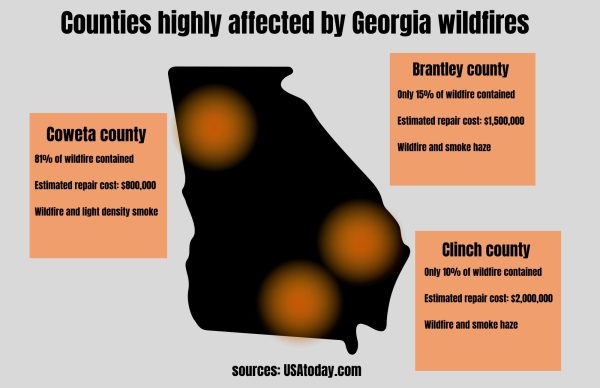



April 22, Georgia Governor Brian Kemp declared a state of emergency for 91 Georgian counties suffering from an outbreak of wildfires. Subsequently, the Georgia Forestry Commission enacted its first-ever ban on outdoor burning for 30 days, ending May 22, due to its danger during a drought. The Florida Forest Service issued a similar ban because they face the threat of extreme fires spreading southward. As the natural disaster rages on, massive amounts of infrastructure and land face heated destruction.
“I did hear about the Georgia wildfires. My mom and I were scrolling on Instagram, and a post came up about it. I’m a little concerned about them. I saw a map of different counties in Georgia, and a lot of the fires are in counties that aren’t that close to Kennesaw or Cobb County, but just the fact that there are close predicted areas of spread and that it’s up to fate with the winds is really bad,” magnet senior Mia Diaz said.
Fueling the flames, the National Weather Service has declared a moderate to extreme drought across southern Georgia and northern Florida. With above-average aridity, dry vegetation encourages the fire to spread with ease. The arid pattern spreads across the entire Southeast, ranging from Moderate to Exceptional Drought in 96.83% of the region and Severe to Exceptional Drought in another 81.75%. These conditions mark the widest sweep of land to suffer a drought since 2000, in which the U.S. Drought Monitor originated. In 2026, the Southeast witnessed four to eight inches of rain below average, marking the extreme shift in weather patterns from the initially expected rainy spring.
The Pineland Road wildfire produced particularly brutal destruction, spreading 31,307 acres near Fargo, Georgia — only 120 miles from Tallahassee, Florida. Firefighters have contained 10% of the fires overall. Equally concerning, Atkinson, Georgia’s Highway 82 fire has engulfed 5,531 acres thus far, facing 15% containment. It blazes 258 miles southeast of Atlanta and has wreaked havoc on 90 homes as of April 24.
The fire in Brantley County also spreads with fiery determination. Wednesday, April 22, county manager Joey Cason stated that residents should prepare for an evacuation, and Friday the Brantley County Sheriff’s Office instated a mandatory curfew from 8:30 p.m. to Saturday at 6:30 a.m. As firefighters labor against the destructive force, locals donate water, food and supplies for those with destroyed homes. Evacuees seek comfort at local churches, such as the Nahunta Methodist Church, where pastor David Farrier welcomes and soothes their anxieties.
As first responders work relentlessly, the fires continue to close roads and wreck infrastructure. As of April 24, the fires have burned down 120 homes and threaten an additional 1,000. Similar dangers threaten northern Florida, and Floridian volunteer firefighter James “Kevin” Crews died from a medical emergency battling the inferno Thursday, April 23. Georgia Governor Brian Kemp urges citizens to obey the burn bans and take extra precautions to avoid possible fires — any emergency would drag firefighters from their vital work.
“I heard about the wildfires from Mrs. [Tara] Sisino. She told us that they were happening and that people were sadly succumbing to those fires. This is impacting because of the loss of homes, loss of property and the displacement. My heart goes out to them,” magnet senior Trevor Smith said.