


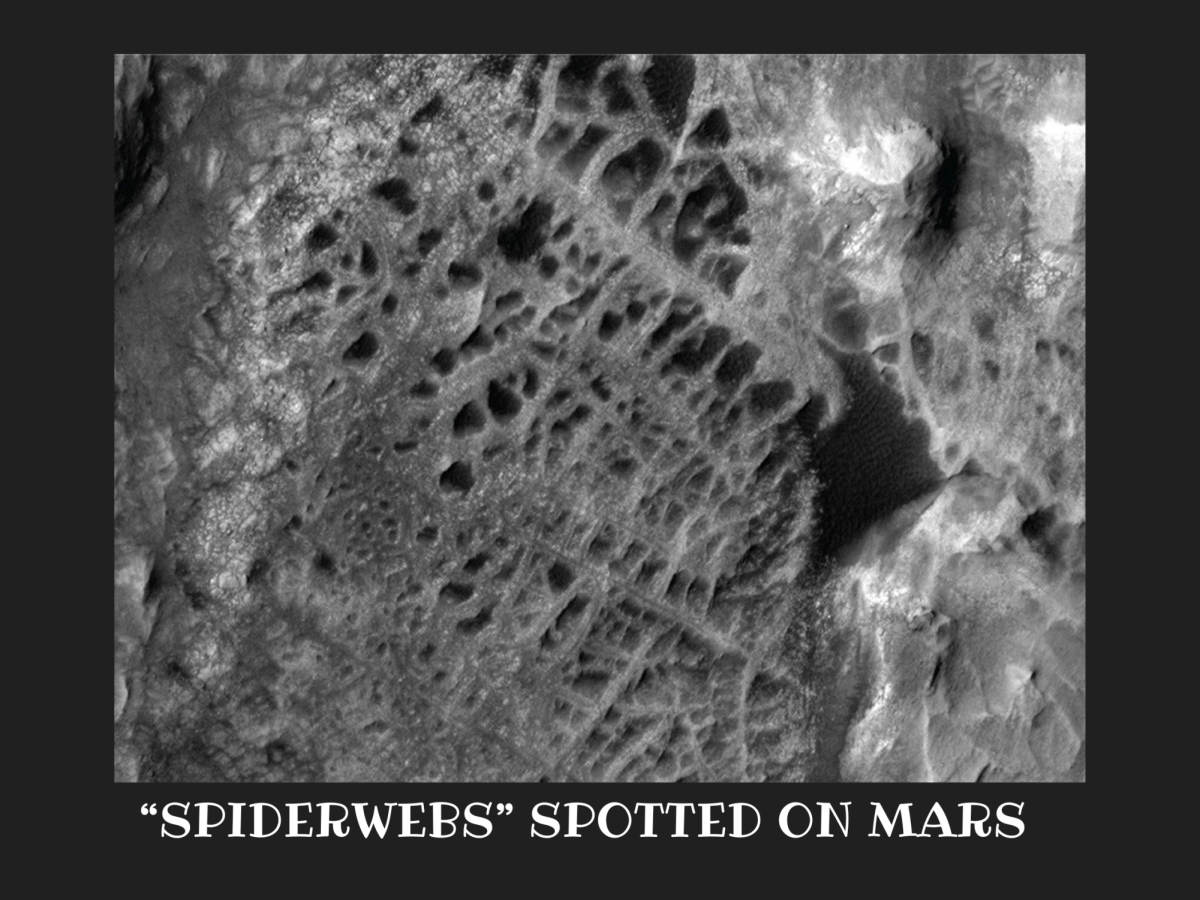
The National Aeronautics and Space Administration’s (NASA) Mars Curiosity Rover recently stumbled upon new discoveries within Mars’ boxwork formation. Never-before-seen photos from NASA showed pea-sized mineral modules that appear similar to spider eggs, covering the surfaces of the already arachnid-like shaping of boxwork. When seen from orbit, the topography of this portion of Mars may appear similar to that of massive spiderwebs. The formations sit on Mountain Sharp, stretching to a total of three miles in height, with the ridges in the formations ranging from one to two parking spaces wide, all connecting in a criss-crossing manner.
According to NASA, groundwater and erosion created these patterns when it flowed through fractures in bedrock, supporting the theory that Mars once harbored life. Understanding the details of these weathered patterns would allow researchers to pinpoint the timeline of when liquid water flowed on the red planet. To obtain this knowledge, NASA scientists attempted to view Mars’ surface more closely. This inspection revealed hollow floors — another sign of groundwater activity — and scattered mineral nodules, which revealed how minerals interacted with water upon the surface.
“I think that this could prove that there was life on Mars, but I’m not 100% sure. I think it’s pretty cool that scientists are exploring different planets, and I think it could help us in the future. I can’t say I’m a big fan of spiders, though,” magnet junior Shaivee Shah said.
As the curiosity rover climbed up and returned from each portion of the boxwork, it photographed the terrain and drilled for samples of the ground. The research revealed that Mars’ climate turned drier with time, experiencing precipitation occasionally, which filled up rivers and lakes on the planet. The rock samples identified that the ridges of the terrain contained clay minerals, and the divots within hollows contained carbonic deposits, showcasing the history buried under Mars’ red dust.
Due to the unique look of the formations, in addition to the new photos of the spider-egg-like modules, internet users stirred up discussions about NASA’s findings. Uninformed individuals assumed that the reveal of said photos truly presented extraterrestrial evidence. Posts on Reddit and TikTok spread this misinformation, claiming that NASA revealed actual spiders on Mars. This resulted in other individuals responding to these assertions, explaining how NASA revealed no biological factors, only the topography of the planet.
Tina Seeger, a mission scientist from Rice University, claimed that the new findings prove that Mars’ climate likely sustained water for a longer duration of time than NASA initially assumed due to the height of the boxwork. Currently, scientists work on finding a location to continue comfortably investigating the narrower sections of the boxwork. A high portion of the terrain reveals stable ground, which scientists can drive on, but certain points of the ground remain difficult to conquer. Curiosity plans to leave the boxwork formations during mid-March as it continues its ascent of Mount Sharp.
“It almost feels like a highway we can drive on. But then we have to go down into the hollows, where you need to be mindful of Curiosity’s wheels slipping or having trouble turning in the sand. There’s always a solution. It just takes trying different paths,” Operations Systems Engineer of NASA’s Jet Propulsion Laboratory, Ashley Stroupe, said.


