
Through hundreds of years, men have expressed themselves in thousands of different ways, most notably through their hair. Men’s hairstyles have changed dramatically from one generation to the next. For example, in the 1980s, mullets, high-top fades and feathered hair gained traction and a handful even resurfaced in recent times, such as with the mullet taking a new, less dramatic form as the modern mullet sports a faded less less-shaved side to moderately long hair in the back with hair cut just above the eyes in the front generally worn with curly hair.
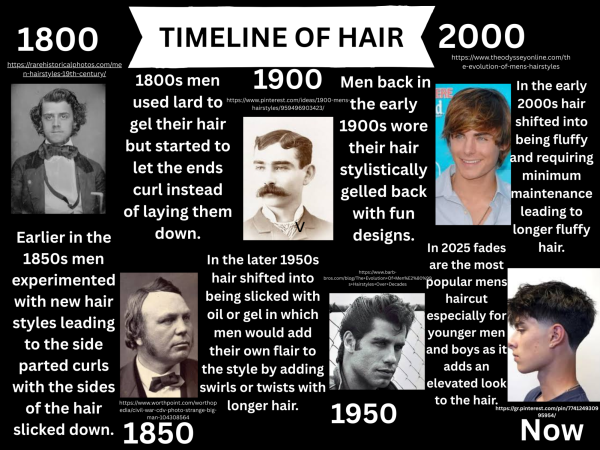
Back in the 1800s, men wore simplistic hair with their hair cut relatively short. They styled the top of the hair forward with the sides slicked back, or they slicked it back into a side or middle part. As the century progressed, hairstyles became intricate and complicated as they left slicking the hair back behind and moved into letting curls flow naturally in a side part with the shorter side gelled down or back.
“Hair for me has changed as I got older, like when I was younger, my hair was always cut shorter, mostly because my mom wanted it to be more manageable for her. When I got into like 7th grade, my hair started getting longer because I didn’t like the shorter hair, and I started trying new hairstyles. In high school, I finally settled for my long, middle part with waves, and yeah, hair has changed for me a lot,” magnet sophomore Hugh Longhurst said.
In the early 20th century, slicking hair back became a popular style again, but instead of using fat or lard as men before them did, they used oil and combed it back, creating that iconic greasy hair look. As the century progressed, the hairstyles changed again, introducing short sides with a side part and hair slicked over, the pompadour, and the classic flat top. Each hairstyle spoke to the person wearing it, showcasing individuality and uniqueness.
Now, finally, in modern times, the number of hairstyles has dramatically increased, with most barber shops and hair salons owning books of hairstyles they offer, or the customer showing the barber a picture of the hairstyle they want. In the early 2000s low maintenance hair was popularized with figures like Zac Efron wearing shaggy hair and others buzzing their hair. As time passed, current hair trends constantly changed, but a handful stayed popular despite the rapidly moving cycle of fashion and trends. Haircuts like fades, specifically taper fades or skin fades, long curly hair above the shoulders, shaggy curls, textured fringes, long or shaggy middle parts and arched middle parts all stand among modern hairstyles that withstand the test of modern trend cycles.
“As a girl, I find men with good hair sense and just good hair in general to be attractive. I personally think that when a man takes good care of his hair and has a good hairstyle that suits him, then he, to me, is more confident and is more physically appealing. Also, I know men’s hair styles change constantly, like my brother changes his hair all the time, and they just try to figure out what works for them,” Kylie Floyd said.
Whether in the 1800s or the 21st century, hair will always define men. As the world continues to turn and new styles begin to gain popularity, hairstyles will continue to change, and men will change with them. As the community of fashionistas looks to the future of hairstyle trends, they continue to invent and create new looks for every man to feel confident in his hair.