
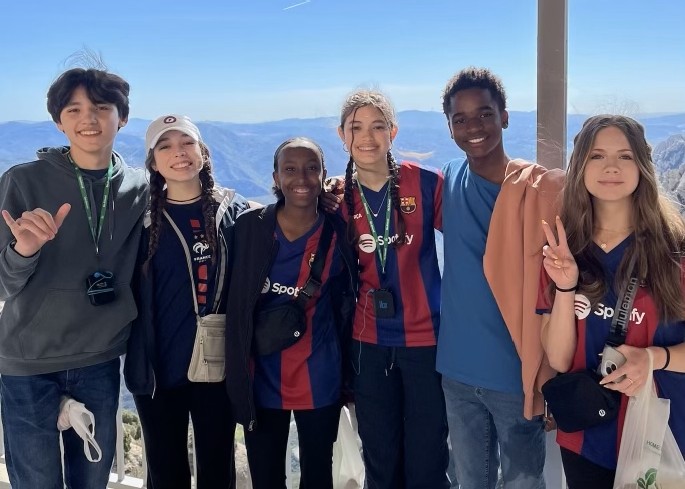
Built on academic rigor and real-life travel experiences, NC’s School of International Studies magnet program (NCSIS) engages students through world travel. The program presents students with four opportunities for travel over their time in high school: two trips freshman year, one trip junior year and finally, one trip senior year. The class of 2027 visited Spain during the spring of 2024, and this upcoming summer, the junior class will fly to Northern Europe and arrive in Scandinavia, exploring the countries with Education First (EF) tours.
“I’m really excited because I went to Spain [during] spring break of my freshman year, so this will be my second magnet trip. I’m really excited because when I went to Spain my freshman year, I was able to make a lot more close friends and build closer relationships. I hope I can do the same in Scandinavia. The only thing I get worried about is losing my passport, but that’s just a normal travel scare,” magnet junior Elise Gallant said.
This upcoming summer, the class of 2027 intends to pack their bags, head down to the Hartsfield-Jackson Atlanta International Airport and board a plane to Scandinavia. These magnet students will visit five Scandinavian capital cities, starting in Oslo, Norway and eventually find their way to Copenhagen, Denmark, Stockholm, Sweden, Helsinki, Finland and Tallinn, Estonia. An expected highlight of the trip includes a two-night ferry, bringing the students to their next destination. Students will throw themselves into the heart of Northern Europe with food to light up their palette, languages to vocalize, music to dance to and architecture to savor. Countless students possess dreams of traveling, especially to five different countries alongside their closest friends, and NC provides them the opportunity to enrich themselves in Northern European culture for a 10-day period.
“I have been chaperoning since 2016, so I’d say I’ve been on fifteen or sixteen trips. The trips are more than just academic learning; the trips take place during February break, spring break, or summer break, so there are no assignments or tests. There are definitely educational tours every day, at least one or two tours led by a local guide or an expert. We’re learning about history, culture, and language. To me, the biggest benefit beyond that is having the students experience a new place, a new culture, getting immersed and meeting local people. Just the experience that comes from international travel is something that helps them mature as students and people,” magnet Biology teacher Grant McDurmon said.
While various parents may view such trips as a waste of money or as an average school trip, students gain lessons on history and culture that no one can earn by sitting in a classroom. Oslo’s architecture, a mix of modern yet traditional buildings, presents students with an insight into how culture affects architecture, or in Tallinn, where students embark on exploring a city known for their Nordic and Baltic cultures. Textbooks can only teach a certain amount; the experience of exploring cultures in person grants lasting knowledge for students.
Although money plays a factor in the number of students who attend international trips, the magnet program luckily offers scholarships to assist students in paying the lofty price. For instance, the Magnet Foundation provides opportunities for financial help to students. Also, the program works to plan trips ahead of time, in order for families to budget the payments into their lives over an extended period of time. The senior trip to Washington, D.C. offers excellent experiences for an affordable price, while international trips further entice upcoming magnet students, possibly persuading them to join or stay in the program.
Magnet courses and trips correspond over the expected four years with the classes and content students focus on, lining up travel with classroom discussions. In their sophomore year of magnet, the class of 2027 enrolled in Advanced Placement (AP) World History along with AP Seminar. AP World History focuses on history from around the world, including Europe, where the rising junior year trip will take place. Either way, AP Seminar and AP World History support a worldwide view of current and past issues, whereas international trips further students’ perspectives on a global scale.
Since 2006, the NC magnet program has hosted a multitude of trips for students, both national and international. The class of 2027 traveled to Germany and Italy for a water conservation summit, and they now plan to visit Scandinavia the summer before their senior year. The trips evoke new learning opportunities and allow students to build community, creating a lasting impact and developing an alternate learning approach.