
Music continues to persist as a heavily influential part for billions of people. It defies the modern constructions of language, gender, race and age, bringing these groups together. For the NC student body, music serves as only one of numerous ways every teen at the school connects with one another. Today, spotting someone listening to music on music streaming platforms such as Spotify or Apple Music subsists as a common occurrence. Undoubtedly, an immense part of music consumption today occurs through interaction with phones and social media platforms such as TikTok and Instagram, but in previous decades, music consumption looked quite different.
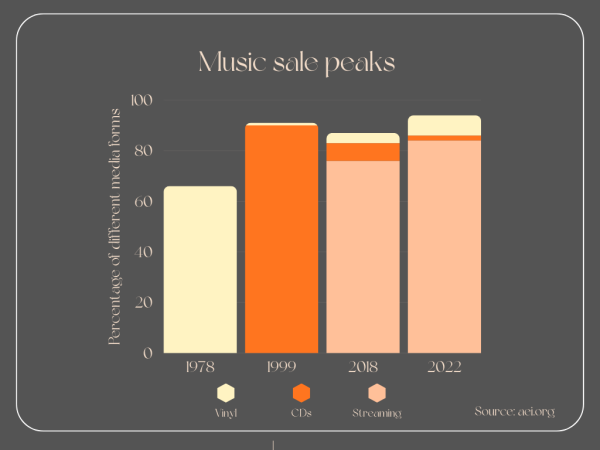
In the past, CDs, vinyl and cassettes existed as the main way for fans to listen to music. Over 20 years ago, physical media generated around 90% of music revenue. In 2000, 938.9 million copies of physical albums shipped into the U.S, and CD sales hit a peak profit of 22.7 billion dollars, but during the mid-2000s, this all changed. The release of the iPod kick-started an increase in accessibility to music. The iPods, among other MP3 players available at the time, held around 5GB of storage. This meant that the players could hold thousands of songs at cheaper and faster rates than ever before, at least until streaming services and social media came into prominence within the late 2000s and 2010s.
“[The music industry] completely changed the way that we find talent, that we sign talent and that we promote the industry of talent. It used to be that you had A&R guys, which stands for Artists and Repertoire, who were the talent scouts. They would be out in the clubs, they’d talk to their friends, and they’d hear the buzz, and go check them out live. If they were really good, they’d pull them in a studio to record three or four songs, and if everyone in the band had a shot, the label would offer them a record deal. Now, all the talent scouting is data-driven, because we can see if the band’s gonna catch fire,” CEO of JAM Inc. Jeff Jampol said.
During 2014, the demand for music streaming rose 54%. Streaming services such as Spotify came to prominence as these platforms allowed consumers access to wider selections of music not seen within the era of MP3s. Since then, the rate for physical media sales fell to 32.9 million copies. In 2022, CDs only produced $482.6 million dollars and even as physical media saw a positive increase in sales in recent years, streaming services still trump revenue. With the introduction of streaming services, the experience of music listening altered momentously. Music lovers around the world, including at NC, now enjoy easily accessible music, and the process of musicians promoting themselves and their projects has evolved into a simpler feat.
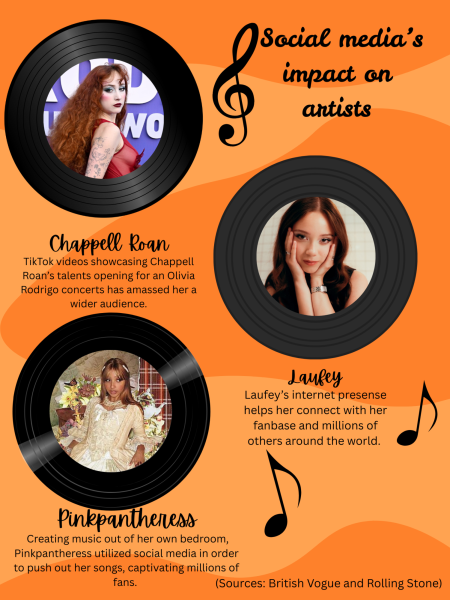
Social media provides hundreds of artists with a way to promote their work in a cheaper, personal way. In fact, TikTok claimed in 2020 that around 70 artists signed record deals due to music promotion on the app. For example, singers Pinkpanthress and Laufey both utilized TikTok to push their music out. When artist Chappell Roan first started out, Roan posted her music on YouTube, racking up millions of views, resulting in Atlantic Records signing her. Years later, while opening for Olivia Rodrigo’s “Sour” tour, the internet once again boosted Roan’s career immensely through TikTok. Shortly after performing at the Gov Ball, Roan claimed to gain almost a hundred thousand followers per day. With social media, artists hold additional opportunities to spread their creations to a wider range of audiences and build a stronger fanbase to brand themselves.
“[I use] TikTok to find music and also my dad. Artists feel like they have to appeal to social media to be successful. That forces them to stay in a box and limits what they could produce, creating this endless cycle of boring, lifeless music. Artists who don’t conform to the standard are often either ridiculed or pushed to the side and don’t get the same appreciation they deserve,” magnet sophomore Katlynn Geder said
On the other hand, for independent musicians who may not possess an adequate team, the jobs of managing and promoting themselves, on top of writing, producing and performing their own songs, can present a daunting task and potentially lead to digital burnout. Anyone can experience digital burnout, but when it applies to musicians, it refers to a state of stress and anxiety that occurs when artists undergo pressure to create promotional content. Factors that influence digital burnout can manifest from poor time management skills, setting unhealthy boundaries, online trolls and harassment, inadequate health and ineffective use of promotional tools.
Plenty of musical artists express their experiences with digital burnout. For example, Billie Eilish decided to leave social media, citing her mental health as the main reason. In 2022, Charli XCX left social media for a period of time due to hate surrounding her fourth studio album, “Crash.” Mitski quit social media following her 2019 tour because of anxieties she felt with her growing fanbase.
Musicians with an online presence can also face real-life danger due to parasocial fans. Parasocial relationships refer to one-sided relationships in which one person believes they possess a real relationship with another person, without reciprocation or knowledge from the other party. These bonds commonly manifest with fans and celebrities. In a study conducted in The Journal of Social Media on Society, fans who frequently used social media, and thus were exposed to their favorite artist repeatedly, became susceptible to developing a parasocial relationship with them. When musicians show their personality or directly address admirers of their work, the intimacy of inviting strangers into their lives could cause fans to think they possess a relationship with said artist.
In the past, parasocial relationships incessantly occurred. During the peak of Beatlemania, parents would bring their sick children to The Beatles’ concerts, believing the rock band possessed healing properties. In 1996, a fan of Icelandic singer Björk committed suicide shortly after sending the musician a bomb due to his belief that he and Björk belonged together. But, in the past decade, and especially since the COVID-19 pandemic, feelings of isolation caused the problem of parasocial relationships to become furtherly common.
In 2016, idol Lay Zhang from EXO reported that fans created false identities in order to break into his hotel. Additionally, 10 days before the incident, another group of fans also attempted to enter the set of a Chinese drama that Zhang acted in. Later on during 2023, Ellish’s stalker threatened to cause harm to her friends and family members while simultaneously professing a profound love toward Ellish. The events led Ellish to obtain a restraining order against the stalker.
“Musical artists and music labels are self-marketing more than ever through their own social media accounts, whether they manage it directly themselves or through a marketing or PR team. As a counter to the usefulness of social media, there are matters of safety and security; for example, an artist posting photos from their home and having someone recognize where it is could result in swatting/doxxing. There have been incidents of celebrity accounts getting hacked or files being stolen. Musicians and music labels have to think about all of this, sometimes even for just one social post,” assistant director of marketing and communications for Boyer College of Music and Dance Madeline Bell said.
The creation of streaming platforms provides millions of music fans with access to an unlimited amount of music. In April 2019, Spotify distinguished itself as an unsurpassed platform when it broke the record for the first streaming platform to hit 100 million paid subscribers. In 2024, the number increased to 236 million subscribers.
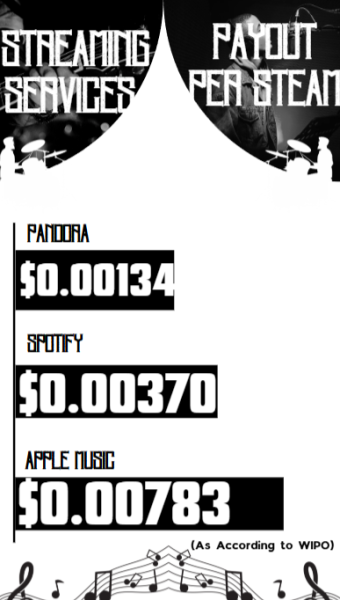
In recent years, the subject of royalties has become a controversial subject among artists. According to WIPO, Streaming platforms generated 11.3 billion dollars in 2019, yet during this time, Spotify paid about $0.00370 per stream, Apple Music paid around $0.00783 and Pandora, $0.00134. However, rights holders, such as record labels, songwriters or owners of a song, receive 70% of streaming revenue generated by Royalties, leaving a meager amount for the actual artist. As of 2024, Spotify changed its policies on what counts as a stream, creating a threshold of streams that an artist must pass through in order to start earning revenue. The policy emerged in order to prevent low-effort spam content from receiving revenue, but it hurts newer, independent artists by withholding revenue.
Social media serves as an integral part of the music industry. The advent of social media platforms such as TikTok and music streaming platforms like Spotify created significantly simpler ways of music promotion. With just a phone, musicians could potentially create a strong fan base and expose their music to numerous music labels. Though social media also holds negative impacts, social media remains an integral tool in the modern music industry.
“[Social media] has changed some jobs, eliminated others and created a whole new industry that needs a different set of skills to survive and thrive. There are a lot of people making a living in music, but it isn’t easy, and it isn’t on a grand scale. You can make a killing, but you can’t make a living, as the old saying goes. Still, there are opportunities, but it takes a strong work ethic, a vision from the artist and a team or group in support of that artist. You can’t make it with just you. It takes a team to create success,” Belmont University professor of music industry history and music business Don R. Cusic said.