


Across all types of media, but particularly film and television, writers and directors crafted female characters who frequently appear as archetypes through the eyes of the male protagonist. Merriam-Webster defines an archetype as “the original pattern or model of which all things of the same type are representations or copies.”
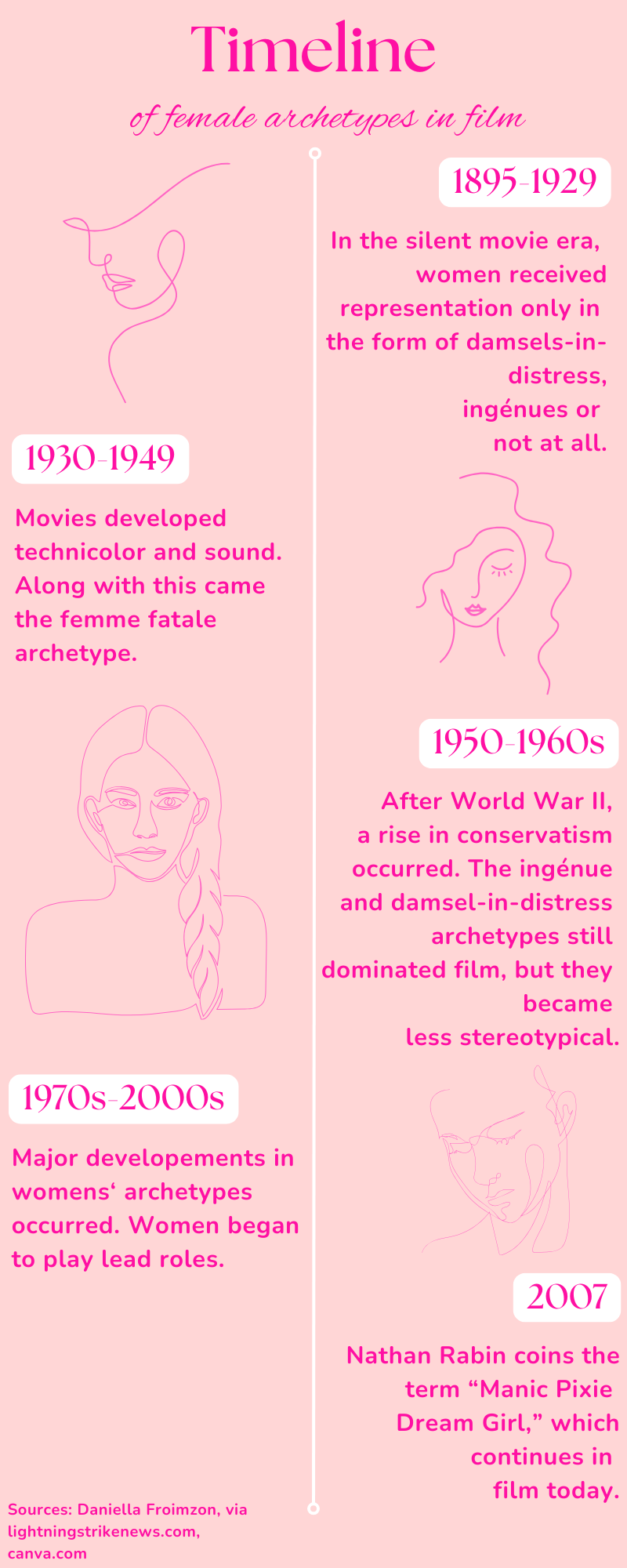
In 1920s film, women, even as protagonists, functioned as either an object to desire or a victim who needed saving. Combined with the rampant sexism in the 20th century, screenwriters did not consider curating purposeful female characters with added details, layers and depth. As society at the time valued men over women, the presence of one-dimensional female characters only abetted the sexism present in society.
The difference in archetypes and stereotypes must receive an address; despite the majority view which considers the two equals, explicit differences remain present. While both representations remain harmful as they impact the behaviors, personalities and psyches of people, stereotypes tend to depict offensive representations of specific demographics. Archetypes, at least, can prove useful as a basis for screenwriters to further develop complex characters if the writers take the time to add nuance, yet the majority of screenwriters do not, which leads to similar harmful effects as stereotypes. Numerous people claim female archetypes act as a tool for filmmakers, yet this claim remains disproven, as archetypes can cause countless levels of distress to young women with impressionable psyches. A particularly notable effect stands out: Archetypes enforce a need to act and look a certain way. Young women feel as though they must adopt this persona to achieve their goals in life.

While countless female archetypes exist, four hold heightened prevalence in modern-day media; specifically, the femme fatale, ingénue, damsel-in-distress (DiD) and Manic Pixie Dream Girl (MPDG) archetypes. The first archetype, — femme fatale — reduces women to their sexuality. This character presents as a sexual temptress who uses her appearance to persuade the male protagonist to focus solely on her, while remaining mysterious and seductive. The femme fatale has developed through various works over centuries. For example, one of the earliest representations of this archetype, the Sirens from Greek mythology, utilized their ethereal presence and haunting voices in the oceans to entice sailors to swim toward rocks, only to drown and die. Ancient representations do not end with Greek myths; in fact, biblical figures, such as Delilah and Jezebel, also portrayed this archetype. The Philistines sent Delilah after Samson to distract him from his duties as a soldier. According to the Bible, Jezebel, a spirit, possesses young women in an attempt to encourage men to commit lustful acts. Despite this archetype’s long existence, her presence still causes pain to young women today.
The femme fatale’s guise of empowering women tends to hide her harmfulness; however, her presence leads to injury rather than empowerment. The archetype’s physical appeal portrays itself as a weapon that a woman can utilize. Her entire character focuses on a hyper-sexualized version of the average female, which promotes the harmful concept that women live as their bodies. The archetype tells young women that as long as one possesses conventional beauty, one can act upon her desires without any consequences. Rather than encouraging girls to focus on their own personality instead of their own looks, the femme fatale teaches women to weaponize their sexuality.
Switching to another archetype, the ingénue, which developed throughout the 16th and 18th centuries, also negatively affects women. Ingénue characters represent naiveness, possessing childlike wonder, purity and kindness. The harshest portrayals of ingénues feature a character possessing no personality outside of innocence. Male protagonists interact with ingénues who receive treatment as though they live solely for a male lead to rescue them from an evil presence. This archetype urges women to infantilize themselves, rather than to possess independence, to appeal to the male gaze. It directly feeds into a patriarchal way of thinking, which encourages women to cater to the male gaze.
“In the traditional telenovela, the typical ingénue, often the protagonist, is always pure and good, and she never changes. Recently, the archetype has become more realistic. However, you have never seen the ingénuity as a weapon because a protagonist would never do that,” University of Georgia (UGA) Professor of Advertising and Public Relations Carolina Acosta-Alzuru, Ph.D, said.
Isabel “Belly” Conklin, from the Amazon Prime TV series adaptation of “The Summer I Turned Pretty” (TSITP), exemplifies the ingénue archetype in a milder contemporary manner. Throughout the series, Conklin’s youth and innocence play a massive part in her romance with Conrad Fisher, who sees her as a child who needs protection. Another example, “The Virgin Suicides,” attempts to criticize the ingénue archetype. Boys obsessed with the five main sisters remain the only perspective that viewers receive throughout the film. All five girls present in an ultra-feminine manner, through the lens of undeniable innocence, the boys’ perspective adds. While the film does stir conversations about the ingénue stereotype, it sails over the majority of viewers’ heads. A multitude of young women across social media unfortunately glamorize “The Virgin Suicides” because of the film’s aesthetic. This glamorization highlights how even a film created with the intention of warning others of this archetype still negatively affects young women.
The ingénue exists as a direct opposite of the femme fatale. For every “evil” femme fatale antagonist, a pure ingénue complements it. These archetypes resemble Yin and Yang or Angel and Devil dynamics: an ingénue cannot commit an evil act, just as a femme fatale cannot commit a moral one. Both of these archetypes act as representations for adolescent women, yet they send different messages. This contradiction poses a threat to young women because female archetypes attempt to teach a young girl how to present herself to society. Fundamentally, conditioning women on their appearance in society becomes a dangerous slope as it encourages women not to live as their true selves. Nevertheless, two prevalent archetypes counter each other, and this contrast proves difficult for girls when they consider presenting themselves.

Initially, ingénues and DiDs seem similar, yet ingénues center around innocence and purity, while the DiD archetype whispers to a woman to let a man save her so she can find love. The oldest portrayal of this archetype traces back to the tale of Andromeda and Perseus in Greek mythology. Acting as a sacrifice for a sea king almost became Andromeda’s fate, but Perseus saved her. For Andromeda to receive assistance from Perseus, he declared that Andromeda must promise to marry him. In the end, the two marry and raise seven children. This myth highlights a leading theme of the DiD archetype: to find love, a young man must simply discover a young woman who needs saving.
Unfortunately, in accordance with the majority of DiD archetypes, the male protagonist saves the woman, and they end up in a relationship. This storyline remains particularly damaging as it communicates to young women that they live strictly as rewards for young men who commit a virtuous deed. For example, in the 2004 film “Mean Girls,” the protagonist, Cady Heron, develops a crush on Aaron Samuels. To gain Samuel’s attention, Heron pretends to fail at math to receive tutoring from him. This film highlights how the modern-day DiD encourages young women to dumb themselves down to boost a male’s ego.
Lastly, the MPDG archetype was developed in 2007 after film critic Nathan Rabin coined the term. The character typically behaves in a quirky, cute manner, which promotes the rhetoric of women functioning as characters beyond plot devices in film. This archetype focuses on a female character behaving in a quirky way without any other personality traits, who operates purely as the reason the male protagonist experiences character development. With her impulsive and perky attitude, the MPDG appears from thin air into a dreary male lead’s life and manages, in one way or another, to use her sporadicity to pull him from depression. Throughout the film’s journey, viewers only see the MPDG teaching the male lead to “live his life,” rather than seeing her live her own life.
The mindset of women lacking ambition becomes amplified through the MPDG. Portraying a female character without any dreams, aspirations or ambitions discredits women’s rights movements. Women notoriously experienced various hardships while fighting for equal rights throughout history, such as the women’s suffrage movement in the early 1900s. Currently, these situations continue to affect women. In the U.S., a gender pay gap, laws surrounding reproductive rights and a lack of representation continue to hinder progress in the fight for equality. As women continue to fight to receive basic human rights, the MPDG archetype romanticizes women acting as mere tools to help men develop, while simultaneously, women fight to receive respect as real people.
Claire Colburn, a main character from the 2005 film “Elizabethtown,” and the original MPDG who influenced Rabin to curate this term because of Colburn’s character acting as a tool to pull the male protagonist, Drew Baylor, from depression. The archetype’s name, while seemingly random, does possess relevance. “Manic” became part of the name due to the quirkiness the average MPDG possesses, and Rabin specifically settled on “pixie” because of Colburn’s bubbly personality, which seemed to belong to another world. Colburn lacked depth and dimension, which earned her character the title of the first MPDG.
Across these archetypes, one point remains exceptionally clear. The majority of these archetypes fulfill the role of side characters due to the lack of female protagonists in film. In 2024, only 42% of the top 100 domestic films featured female leads. Additionally, in a 2023 study, 58% of respondents asserted they believe the portrayal of women felt underdeveloped and stereotypical, meaning that the tiny amount of representation young women do receive remains tainted by the lack of development present in these characters.
“I unfortunately have felt affected by these archetypes. It is a lot to see women on my screen acting only in one role and then being told that I should ‘spread my wings.’ A lot of it comes from sexism and the patriarchy, I think. Even nowadays, casual sexism is so rampant, and I feel like it is definitely visible in the ways women are portrayed through television,” magnet junior Ellie Shields said.
Archetypes also add pressure and create feelings of insecurity. These emotions follow into adulthood, leaving long-lasting effects. Multitudes of women also feel as though they must shape themselves to fit into the mold archetypes set. However, women exist as individuals with their own separate personalities, lifestyles and goals. The media evokes feelings of insecurity and inadequacy in women, but no woman should feel this way because of her variance from the archetypes represented. Additionally, these “molds” developed in film throughout the past 140 years, meaning around eight to nine generations of women felt this pressure to portray themselves in a specific way.
The ingénue, MPDG and DiD archetypes include characteristics that contradict the femme fatale, yet they all try to urge young women to perform to achieve success, male validation in this instance, in life. These effects lead to women developing a persona in order to achieve their goals. Additionally, when transitioning between professional and personal lives, women struggle to leave these personas behind.
“Women struggle to move between or turn off their personas developed from archetypes in their personal lives. Since they have developed this persona in order to reach success or be taken seriously in the workplace, it essentially follows them beyond the professional spaces they are involved in. The problem is especially bad when a woman works in a male-dominated field,” Kennesaw State University (KSU) Associate Director of the School of Communication and Media and Associate Professor of Communication Robin Mathis, Ph.D, said.
While each of these archetypes possesses its own separate potential to do damage, together, they reach a nexus. No matter the archetype, young women feel pressured to act or behave a certain way to receive the lives they want. According to Common Sense Media, 75% of girls feel that television and film influenced the way they perceive themselves. Instead of encouraging young women to act as their true selves, film and other forms of media push adolescent females to shrink into themselves and put forth a fabricated persona. These behaviors follow young women as they develop into adulthood and negatively impact their lives in all aspects. Due to these effects, it remains imperative to create media that inspires young women to portray their real selves.