



As high school seniors enter the college application season, questions about how to pay for higher education swirl through their minds. Upcoming university students wonder about qualifying for federal grants, scholarships and loans, but the answer sits only clicks away. For the majority of students, especially those seeking monetary support in college, the Free Application for Federal Student Aid (FAFSA) will force itself onto the college application scene. This form will account for the student’s and his or her parents’ tax information and other circumstances to calculate the degree of financial assistance the student can qualify for.
“[I filled out the FAFSA] around September 30-October 2, a little bit before the official opening of it. [It was] not super difficult. Most of the information they asked for was pretty standard, for example, social security number, parents’ financial info, identification, etc. [It was] way easier [than I expected]. Based on your social security number, it does half the work for you with the financial stuff. [I’m] totally content. I got all my information within two days, so super easy process,” magnet senior Tiffanie Nthale said.
Notably, Georgia students aiming to receive state-level scholarships may also choose to complete the Georgia Student Finance Application (GSFAPP). The Helping Outstanding Pupils Educationally (HOPE) and Zell Miller scholarships, among related grants, necessitate this form or the FAFSA. Luckily, finance authorities have streamlined both processes, so a prepared student should not struggle to complete either quickly. The FAFSA will typically suffice to qualify for both federal and state-level aid.
The FAFSA gained a reputation as a slow and grueling process over the years, considering its in-depth questions and last year’s technical issues. As it opened September 24, applicants noticed immense improvements. Now, the form loads promptly, asks questions clearly and returns information quickly.
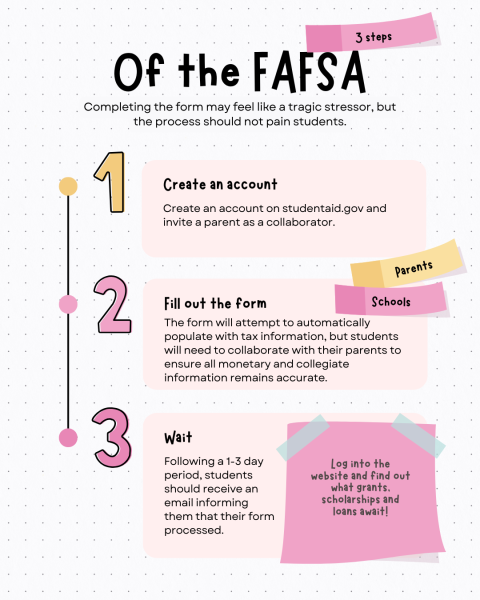
The first step to the FAFSA involves creating an account. Students input their names, email addresses, social security numbers and other important information so the government can tie their monetary information to their new educational profiles. With this step completed, students can send a parent an invitation to input his or her tax information. Parents can open the invitation in their emails and answer the site’s questions quickly, with parts automatically populating. For students who earned taxable income in the previous fiscal year, the form will also require an understanding of the student’s finances.
After the quick process to share financial and personal information, the form will ask the student which colleges he or she would like the results shared with. Though those already enrolled will only provide that information to one school, high school seniors can select up to 20 colleges they will apply. They can edit this list later on if their chosen schools change.
Once the students complete these steps, they can submit the form. Within 3 business days, the FAFSA will inform them that the U.S. Department of Education has processed the information. Upon logging back into his or her account, a scholar can learn what loans and grants he or she qualifies for. Ultimately, the process rarely takes longer than 30 minutes, but it can grant students access to high-quality education for years.