
Dating back to July 1, 1980, when the first newspaper — The Columbus Dispatch — transitioned to an online format, the world experienced a significant shift in the access and reliability of news. Now, 46 years later, the dissemination of information has spiraled into various hands, including those who hold superior political power in a myriad of countries. While NC students will take in quick pieces of information from TikTok or Instagram reels, in certain cases, this information could mislead them about world events and the reality of the power of those leading the nations. Considering that social media can become a haven of doomscrolling for teenagers, NC students should examine the reliability of favored news sources and evaluate the extent of government investment within the content that fills their ForYou Pages or news outlets.
“I think state-run media can impact the perception of the nation from a high schooler’s perspective, as many issues never get covered, and they can give the nation a ‘bad representation.’ This can lead the high schoolers to seek their own information out from outside media sources, leaving them feeling exasperated from the lack of true media coverage. I think private media sources are better to get the most impartial, unbiased information on varying issues,” magnet senior Tiffanie Nthale said.
After the ban on TikTok in early January 2025, U.S. consumers have questioned the surveillance of videos that creators post due to the shift in media ownership. Because the U.S. took control of the app January 22, 2026, when President Donald Trump signed a new entity into place, the TikTok USDS Joint Venture LLC, the board now consists of about 80% American investors and 20% ByteDance investors. This new build leads users to grow wary of the content they consume. While a number of scrollers take what they see with a grain of salt, others examine the information and analyze what they consume in comparison to TikTok pages in a country with state-run media. By identifying minute details such as China’s educational-only videos for teenagers 14 or younger and the U.S.A.’s personalized, addicting content, consumers can understand how other countries, such as China, obtain intensely government-controlled news. The manipulation by state governments leads to extremely watered-down information for the people and a lack of questioning of those in power.
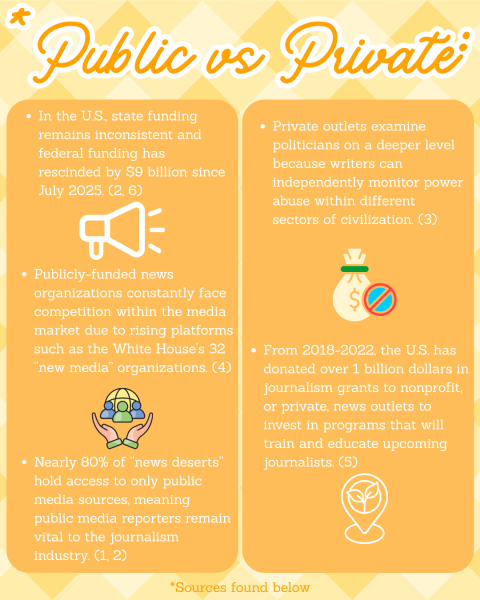
In defining state-run versus privately-owned outlets, a distinct line emerges between the two modes of news gathering. In discerning what information to or not to trust, one should examine the writer’s credibility and the politicians in office to fully understand the impact of power within the region. In addition, while state-run media and public media hold similarities, public media outlets simply earn funding from the state to run extremely accessible news to bridge gaps between communities. This public form of media allows for unbiased, reliable news with wide public relations budgets. With the influence and common oppression from officials in countries such as Russia, journalists find themselves debating the ethicality of state-run outlets. Specifically in the U.S., although all media operate free from government interference, the vitality of informing society on public policy issues, economic struggles and community hardships grows due to the importance of a healthy civil society. Unfortunately, countries that encounter censorship through the editing of articles, videos or podcasts do not receive the opportunity to embrace the freedom of an open press.
“There are certain topics that need to be covered, but I think it’s really difficult. And I think often they’re told that there’s something going on in the world and we have to spread our interpretation of it, right? So if there’s a war, for instance, one country is calling it something else, and you want to interpret it as a war of aggression versus for liberation, I think that’s often what happens in these state-run news outlets. The way you interpret world events is what matters. I think it really depends on the country and how severe the limitations are. I’ve spoken with some people in Vietnam, and they have a lot more freedom to navigate. China is much more difficult, and Russia is very difficult. I know you are arrested if you call a war if they [the government] don’t want you to call it a war,” Assistant Professor at the University of Georgia Department of Journalism Karin Assmann, Ph.D. said.
To examine the level of press freedom throughout the world, organizations such as Reporters Without Borders study the political, economic, legislative, social and security indicators that impact a country. These factors especially help establish the reality of a country’s media landscape. For example, Russia stands at number 171 out of 180 on the world press freedom index, which has increased since the 2022 invasion of Ukraine. The rising index reveals the almost completely banned, blocked or “foreign agent” status of independent media outlets. This changing index shows the stark increase in censorship in only four years.
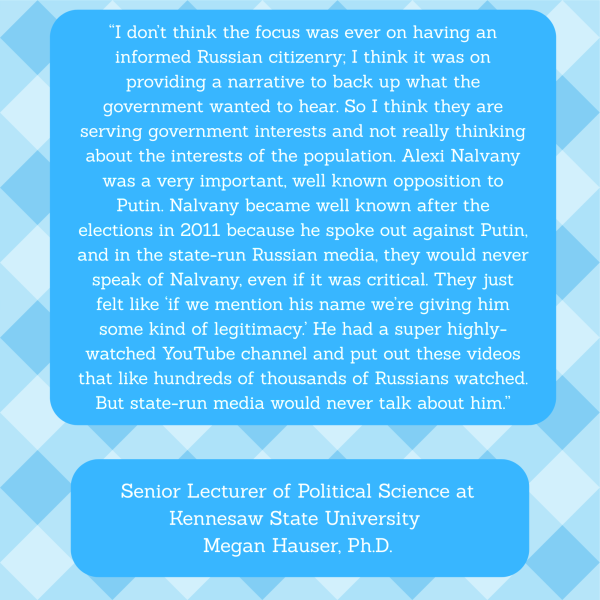
In Russia’s state-run media, consumers only intake information that the country’s media regulator, Roskomnadzor, did not edit out of news sites. Therefore, all outlets operate under the ownership of the president or Kremlin allies so that they can monitor and ensure that the public cannot access certain subjects. While Russia experiences intense undemocratic measures throughout the press, democratic countries also undergo restrictions from their governments.
While observing countries such as Germany, which, in theory, should operate with a free press, negative impacts arise from its dual system media landscape. When defining a dual media environment, these countries obtain two main pillars of press freedom: public service broadcasting and private commercial media. These pillars become protected under Germany’s Basic Law, which guarantees that “every person shall have the right freely to express and disseminate his opinions in speech, writing and pictures and to inform himself without hindrance from generally accessible sources. There shall be no censorship.” Although the country acknowledges the importance of journalism, the consequences of private commercial media emerge. For example, when comparing the foundations of state-run and private media, various individuals automatically support the values of private entities, but, in reality, both systems bear issues that reflect in the content they produce.
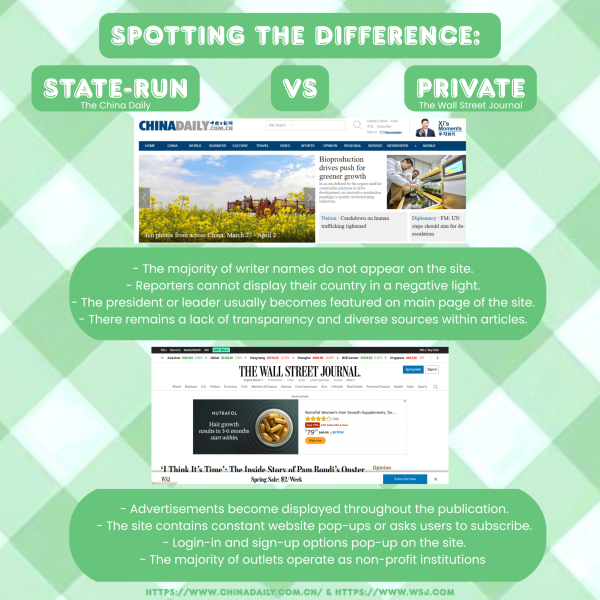
To dial in on private media sources, a majority of these become funded by corporations, families, shareholders, and they rely on subscriptions and advertising. In a sense, these outlets become guided by a profit incentive and usually compete in a media marketplace under News Corp, also known as a pluralist media system. Currently, there remains no distinct percentage of the world’s private news outlets under the management of News Corp, but the organization continues to stand as one of the dominant conglomerates controlling international publishing since 2013. These entities could fall into publishing biased reporting — usually following political agendas — and experience editorial suppression due to sensationalist coverage aimed at intriguing readers to purchase memberships. In all, without journal subscriptions or advertisement successes, private media outlets could face intense drawbacks because of their financial independence from the government.
“With private incentive bias, that isn’t what the public needs to know, but it’s what the public wants to know, and that’s not the deepest, long-form of journalistic investigation of what the government’s actually doing. So there’s a commercial bias that prioritizes entertaining stories over heart-wrenching news. There’s a problem with ownership, you know, these corporations have an incentive to produce and publish stories that are favorable to an economic sort of philosophy or to the corporation itself. And so there’s this idea of self-censorship in a private media environment where there can be political pressures put on these companies, so in order to continue to get information, they have to sort of appeal to the governing authority. So this is really a paradox to a free press,” Political Science Professor at Kennesaw State University (KSU) Jeff DeWitt, Ph.D. said.
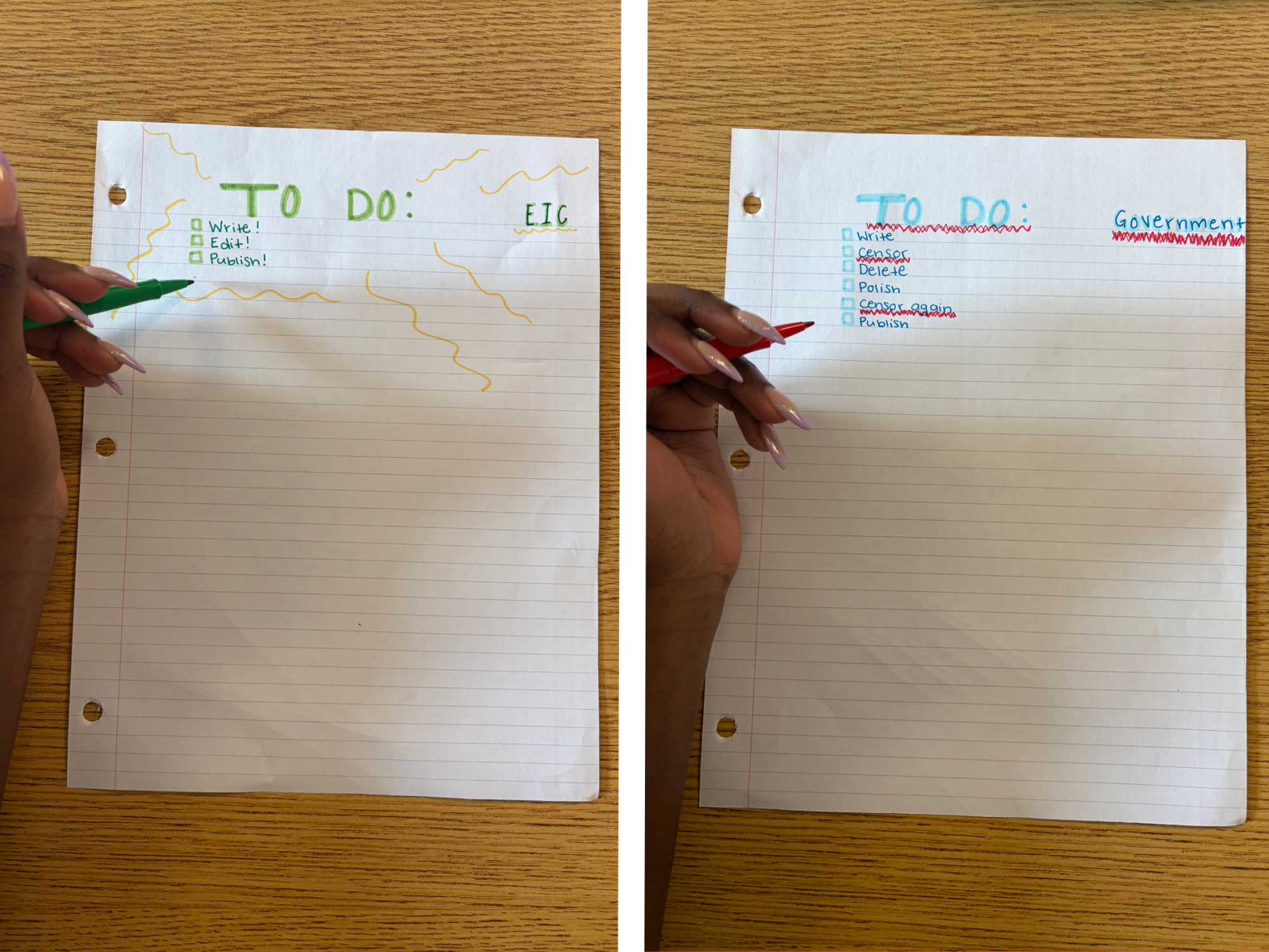
On the other hand, the variability of state-run media can fluctuate from a slight degree of editorial freedom to a news outlet becoming a government mouthpiece, leaving it difficult to determine the guidelines for what a country can or cannot deem as censorship. For instance, North Korea experiences direct government oversight within the media, and civil servants simply work for the government itself. Even in these harsh press environments, countries that utilize state-controlled outlets experience highly effective communication. In certain cases in North Korea, the news stations work efficiently to relay any information deemed critical to its citizens, such as natural disasters or public health needs. Despite the effectiveness of state-run media, cons outweigh the pros of these organizations. Due to the lack of independence, government accountability and credibility from entities such as North Korea News (NK News), the publisher suffers due to a lack of international support from neighboring countries.
As debates rise on the reasonability of a free press in authoritarian regimes, the lack of a country’s journalistic rights proves extensive harm to its international ties. As countries decipher which of their neighbors to trade with or which to claim as allies, the soft power the government holds also influences its reputation. While soft power does not tangibly add up to a specific number among countries, the power determines the ability of one to obtain the outcome they desire through attraction rather than coercion. Values, beliefs and external perceptions of a country determine its soft power, so those with a state-run press face faltering diplomatic relations since a free media landscape has grown into a shared value within international communities. This shared value continues to grow stronger as a free press ultimately determines the health of a country’s civil society and the reality of government interference within the lives of helpless and intimidated citizens. Whether a country controls its media or outlets run independently, the implications of each eventually come to the surface in various ways, even through TikTok ForYou Pages.