


As the modern world flings its digital users through the unavoidable usage of progressive technology, approximately 68% of teenagers find themselves using Artificial Intelligence (AI) chatbots on a daily basis. While this habit may provide temporary joy or satisfaction, the utilization of such tools can quickly spiral into a dangerous addiction. High school students, like those at NC, particularly suffer from such dependencies, marking their lives with a deteriorating academic performance, negatively impacted mental welfare and long-term repercussions on their cognitive and creative capabilities. This negatively affects the educational atmosphere for both students, teachers and parents alike.
Chronic and compulsive need for a certain substance, behavior or activity, despite harmful consequences, defines the term addiction. In the context of AI addictions, individuals suffer from an insatiable reliance on generative content, presenting a snowballing issue for teenagers, especially. This audience remains susceptible due to a strong desire for social connections, personalized academic assistance and its unprecedented convenience. As such, AI’s presence in the academic world has increased exponentially, leading to the rise of dependence on such tools.

Out of 20 of the highest-trafficked educational websites globally, 17 incorporate AI into their programs. This includes Outlook, headed by Microsoft and used by school systems as an emailing platform; Google searchbars, the world’s major search engine; and Quizlet, a popular flashcard and study site for students. Undeniably, AI offers a personalized educational experience to its users, and certain study tools, such as Knowt, apply engaging and useful methods to learning. Yet as AI incorporates itself into educational tools, the difference between utilizing one’s resources and blatantly relying on them defines the difference between accessing help and becoming addicted to it. Additionally, in 2025, the CollegeBoard reported that the population of students using AI tools rose from 79% to 84% across the months of January to May. A world without AI incorporated into education no longer exists, forcing students to approach their academics with unprecedented methods of personalized and advanced learning, or allowing individuals to take advantage of the aid to complete their work.
“I think the school system values grades more [than learning]. I think this can lead students to only remember things for tests and quizzes or even cheat on them, meaning they aren’t actually ‘learning the content.’ AI can be enticing because it is so easy to use and can give you direct answers instead of having to research them. It is not worth the costs at all, though. I think the pressure that students are under can make an addiction to AI so easy to fall into because it can just make things like note cards or memorizing easier and take less time for students with busy schedules. I think it [a positive or negative effect from AI] really depends on how schools react to AI in the long run, because I have definitely had teachers who have said, ‘ask ChatGPT for stuff.’ I think if they [schools] don’t start to really start prohibiting it, it will lead to a decrease in education,” sophomore Hope Devlin said.
While students experience a rapidly shifting academic world, teachers also bend to the will of AI. From 2023 to 2025, the percentage of teachers using AI tools in the classroom nearly doubled; popular sites in curriculum now include Khan Academy, Canva and Kahoot!. Educators turn to AI both for search engine research and to understand how to regulate generative AI in the classroom. This use further embeds AI both into the academic world and the minds of adolescents. Similarly to students, the dependence on AI in the academic world varies from educator to educator, but the presence of generative tools still rises rapidly, concerning individuals over a potentially AI-dependent future.
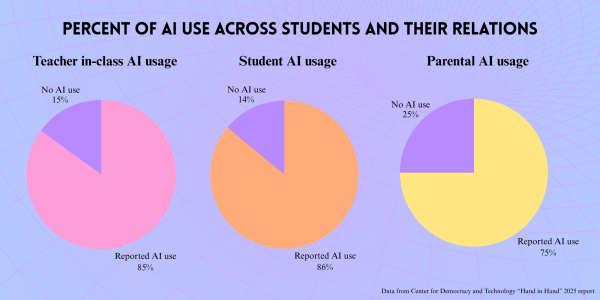
The normalization of AI, integrated into everyday life, spurs the unhealthy overuse of such platforms surrounding adolescents’ daily lives, promoting a reliance outside of academics. As AI worms its way into search engines, social media and smart homes, individuals find the presence nearly impossible to ignore; for example, AI in social media provides the convenience of text summaries, search suggestions and video translations. Through no fault of the users, a majority of the netizen population may gradually surrender to its presence in the modern world. Generative tools wield strategies and programs designed to capture users’ attention, purposefully blueprinting their platforms as accessible and gratifying. Teenage students — a population raised in a technology-dependent era — simply cannot avoid the AI presence in their phones, digital study tools and social media.
“The effects of AI on youth are nuanced and complex; AI is not all ‘good’ or ‘bad.’ How AI affects an individual depends on factors such as the specific application, the design features of applications, the data used to train AI systems, and the context of the use of these technologies. Also, different people may react to the same content in different ways; individual differences—such as temperament, neurodiversity, exposure to stress or violence, social isolation, traumatic experiences, mental health, age, and/or exposure to socioeconomic or structural disadvantage can all affect responses to content or online experiences,” senior research scientist at the Wellesley Centers for Women and director of the Youth, Media and Wellbeing Research Lab Linda Charmaraman, Ph.D said.
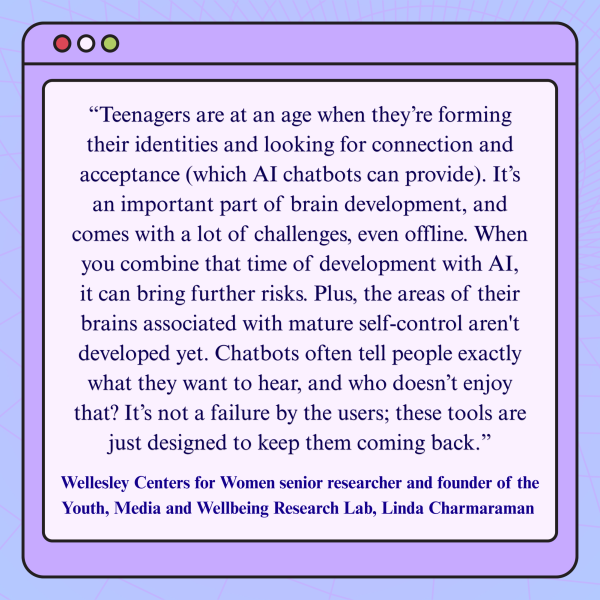
A dependence on AI, while dangerous simply in its addictive nature, promotes long-term consequences on cognitive thinking, social relationships and mental health. A reliance on generative tools prompts computers to think for their users; information exists at the tip of one’s fingers, reducing the need to comprehend critically. The sheer convenience of information from AI leads to an unexercised brain, and thus, individuals’ cognitive abilities may suffer. In a Massachusetts Institute of Technology (MIT) study, researchers found that participants relying on AI to write an essay underwent a 47% collapse in brain activity. With generative sources carrying the weight of an assignment, students do not need to work their minds. Additionally, the addictive and easy-to-access nature of generative conversations prompts individuals to withdraw from real-life relationships as they seek a dopamine hit of agreeable and quick-paced responses; as users dive deeper into the enticing conversations, they experience degrading social skills and become isolated from interactions necessary for mental wellness. A lack of engagement links directly to both mental and physical challenges, including disorders such as depression, anxiety and substance addiction; decreased quality of sleep; poor executive function; and physical health issues, including a harmed immune system, diabetes and dementia.
Loneliness especially drives individuals toward AI addiction as netizens seek connection and solidarity. The World Health Organization (WHO) reports that 17% to 21% of people aged 13 to 29 reported feelings of loneliness, with the highest levels experienced by teenagers. In this way, adolescents may face the highest risk of relying on AI for camaraderie; of teenagers utilizing AI, 16% report using it for conversation and 12% report seeking emotional support. A loop of desolation emerges from such feelings and AI interactions: feeling alone, individuals may turn to AI, thus isolating themselves from real-world interactions.
57% of look up information and 54% use the generative tool for schoolwork aid. Additionally, one in five teens receives news from AI, rather than from human-sourced and credible intelligence. This method of acquiring information presents a danger of misinformation, as generative tools fail to report with complete accuracy. OpenAI, the developer of ChatGPT, specifically details that the chatbot runs a risk of producing false or misleading results, portraying information with confidence despite fabricated answers. OpenAI refers to this experience as a “hallucination,” which describes factually inaccurate responses such as false definitions, dates and facts; quotes, studies and references to sources that do not exist; and presumptuous responses to questions facing ambiguity and complexity. To prevent misinformation, OpenAI recommends that individuals turn to reliable sources for information. If AI serves as a person’s main source of facts and news, a distortion of information heightens the risk of uninformed and dangerous opinions and actions.
Although battling the ubiquitous presence of AI seems nearly impossible in today’s technological age, individuals may prevent a dangerous addiction through the use of various resources and settings. For example, certain apps and sites offer AI-disabling options. Google’s Gemini appears on search bars, but with a right click and a press of the “unpin” prompt, the normalized accessibility to the generative site finds itself out of sight, out of mind. Additionally, users can add “-AI” to their search for the purpose of removing the Gemini overview in their search results. Through the conscious effort to avoid generative information in place of human-made websites — especially to seek credible sources from experts in a respective field — individuals practice an engaged cognitive approach to learning. Different search engines and apps offer their own respective tools to avoid AI shortcuts and reliance. When researchers cannot avoid AI in a site, they must simply turn past generative responses and actively seek credible answers under the understanding of AI’s addictive and occasionally fictitious nature.
“Students could become addicted because of AI’s easy access to information without needing to study. I think it could be harmful when they don’t need to actually learn the subject for passing grades, but I also think it helps kids who aren’t fully understanding and need some quick help. I think it could cause students to focus less on teachers, so I guess it has a negative effect on schools. It will cause students and future adults to have less knowledge since they are so focused on easy-access information,” senior CJ Goff said.
Ultimately, the presence of AI has quickly surrounded the educational landscape, offering an addictively convenient supply of fast answers, conversation and generative camaraderie. While its appearance across today’s technology remains nearly inescapable, the cost of becoming reliant on such tools outweighs the dopamine hit of quick responses. AI reliance not only induces a degraded cognitive ability, but leads individuals through the unpleasant aspects of a typical addiction: anxiety and irritability, social withdrawal, disrupted sleep patterns and a dangerous dependence on the source of their addiction. Nonetheless, vigilant minds spur a successful society; students and nonstudents alike may benefit from an active understanding of the consequences of AI and how to safely manage its usage.