

In the 1970s, Japanese roboticist Masahito Mori began his quest to answer the eerie question plaguing the newly popularized animatronic industry: how the devices could welcome anything other than enjoyment and excitement. Popular toys such as puppets, dolls or mannequins should spark joy and laughter in children; however, Chuck E. Cheese’s owners and psychologists alike began to notice children’s repulsion or fear toward these outwardly cute and friendly characters with collective unease. This unexpected reaction drew attention toward the seemingly primal aversion for near-human replicants. Thus, with the publication of Mori’s 1970 “A Phenomenon of the Eerie Valley” essay, scientists began to debate the true causes of this innate repulsion for the imperfect impersonations of almost-human entities, known as the uncanny valley effect. NC students and other high schoolers now turn to Artificial Intelligence (AI), increasingly encountering this uncanny feeling through human-like responses.
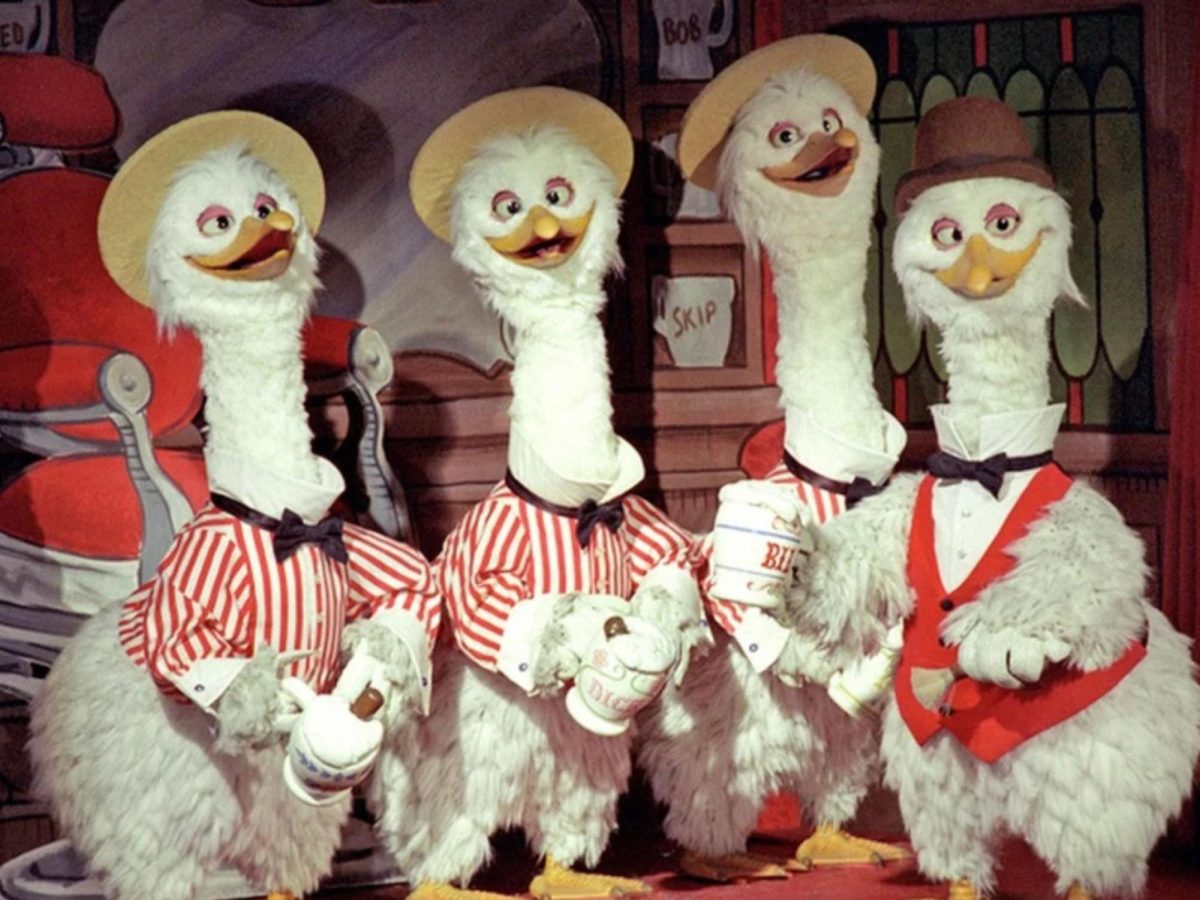
The 1960s animatronic craze began with Walt Disney’s introduction of Audio-Animatronics in Disney attractions such as the Enchanted Tiki Room and the 1964 World’s Fair. After their famed debut, this technology became the pinnacle of children’s entertainment, appearing in kids’ shows, restaurants and theme parks around the world. The 1970s marked a period of technological refinement, paving the way for the peak of animatronics: the 1980s. From blockbuster movies to local fast food restaurants, animatronic and robotic characters appeared everywhere. In the late 1990s through current times, however, the development of increasingly realistic Computer-Generated Imagery (CGI) technology corresponded with the drastic reduction in the use of animatronics in both film and other industries. Culture critics argue that the introduction of modern technology caused the downfall of these characters, while others insist that their creepy nature prompted their decline into obscurity.
“I believe that the uncanny valley is a compound effect. Generally, we do not feel uncanniness or eeriness toward simple geometric figures, even when they are morphed, unlike human-like robots or faces. Thus, categorization failure may trigger the uncanny valley, but it does not account for it entirely. After this initial ‘trigger,’ our cognitive systems may amplify the resulting negative feelings. In my opinion, obvious errors can lead us to correctly categorize an object as something else. I think it is difficult to directly link the uncanny valley to moral disgust, because the uncanny valley can arise from simple perceptual features regardless of our moral judgments. However, the uncanny valley is not experienced in the same way by everyone. There are individual differences in sensitivity to the uncanny valley,” Chua University researcher Kota Sasaki said.
Biopsychologists argue that biological factors perpetuate the uncanny valley effect, which features phenomena such as a powerful sense of unease around human-like entities. The human brain constantly predicts incoming sensory input from the surrounding environment. When viewing a nonhuman object, the brain experiences a series of cognitive contradictions, struggling to determine between human or an inhuman organism. Researchers found through functional magnetic resonance imaging (fMRI) scans that the medial prefrontal cortex begins to activate while viewing uncanny photos or objects. This region of the brain involves emotional processing, social cognition, decision-making and memory, suggesting that the uneasy feeling from the uncanny valley could be tied to the construction of the human brain, neurochemical connections and physical stimulation, all resulting from the brain’s inability to properly assess threats.
“In biology, the main goal of organisms is to reproduce and pass on their genetic information to the next generation. Survival is tantamount for the attainment of this goal. It is in the interest of all organisms, including humans, to have instincts that would allow them to detect danger even when they may not be fully aware of what that danger is exactly. Thus, humans who have that instinctual fear have it as a result of natural selection since individuals who are adept at detecting danger will evade situations that threaten their survival. After all, being overly cautious is not costly. For example, if there was no danger and you flee, there is no harm done. However, if there was danger and you did not flee, your survival is at stake. The uncanny valley effect may just be another example of the human body detecting danger that your mind may not fully be aware of,” NC biology teacher Juan Mora said.

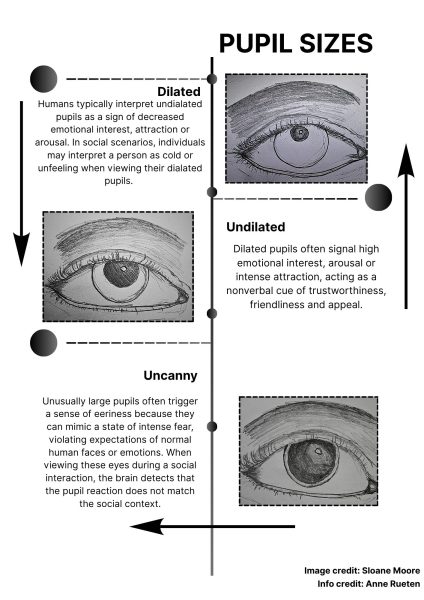
Building on biopsychologists’ beliefs, evolutionary biologists believe that this fear response derives not from the biological structure of the human body or brain, but from predetermined survival mechanisms that trigger the avoidance of potential dangers. These uncertainties typically stem from the fears that troubled ancient human ancestors — disease avoidance, predator detection and confined spaces — which may pose a risk to survival. A primary theory suggests that features associated with sickness — pale skin, strange movement, abnormal facial expressions — correspond with triggers of the uncanny valley. Similarly, these features also resemble those of a human corpse, historically associated with disease, infection and decay. Other biologists argue that the uncanny valley stems from a cognitive need to identify and avoid predators, a signal humans recognize primarily through the size of their sclera. The white part of the eye, or the sclera, plays a key role in conveying emotion. Typical of this phenomenon, uncanny eyes will feature a disproportionate, unnatural or missing sclera. Human eyes feature highly visible and distinctive sclera, while artificial characters such as robots typically lack one completely. Likewise, the pupil also acts as a sign of emotion and attraction. In social interactions, distorted pupils may indicate potential health or neurological issues. These subtle deviations in eye structure constitute a primary trigger for the uncanny valley effect, causing artificial beings to appear eerie or unsettling rather than truly alive.
“I think the uncanny valley has a strong experience component: That is, currently we do not yet have that much experience with artificial stimuli, but as we will have more and more experience, I expect the uncanny valley to get smaller over time, at least for a certain class of stimuli. In the same manner, it would also be very interesting to look at how children experience the uncanny valley, whether they even feel it for the same visual objects as adults do or not,” Professor of Neuroscience and Psychology at Dortmund University Sarah Weigelt, Ph.D. said.
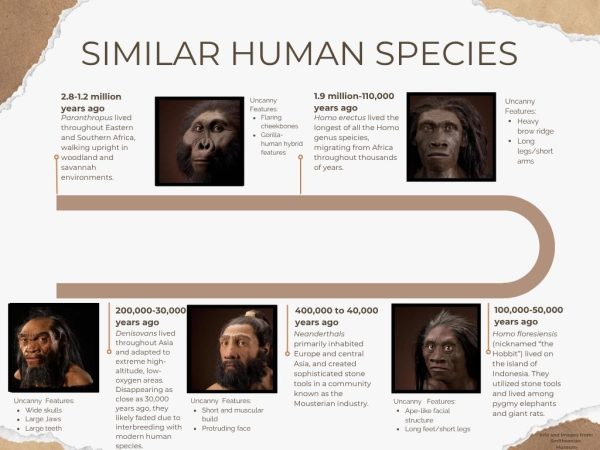
When viewing an entity resembling a human, the brain signals discomfort due to its physical difference from normal human anatomy. The Ancestral Mimic Theory also suggests that in the times of cavemen, animal or near-human relatives such as Neanderthals evolved to appear human-like to hunt and kill cavemen for food. As the theory suggests, early humans evolved to quickly detect and avoid any subjects that resembled a human to survive. Consequently, humans naturally developed an aversion to human-like entities as a way to avoid facing deception or death.
The roots of the uncanny valley remain unclear; however, psychologists now argue for a profoundly darker and deeper explanation. Highly realistic artificial replicants blur the lines of what humanity truly entails. Especially with the rise of AI and other advanced technology within the past decade, the fear of replacement or a lost identity grows exponentially. The Social Identity Theory states that humans define themselves through contrast with non-human individuals, so when the line becomes unclear, it leads to a sense of discomfort and fear. The uncanny valley arises from a threat to social identity, where near-human entities make humans uncomfortable by blurring the lines of humanity, violating the need for a distinct human category. AI grows increasingly present in daily lives, especially impacting academic and student performance. Uncanny valley exists to warn humans of imminent threats, but if AI surpasses that risk threshold, humanity may face a significant shift in cognitive dissonance.
54% of students say that the human-like nature of AI allows them to ignore any aversion they feel and that they frequently rely on AI as an educational assistant — a frustrating issue for teachers. Because AI can closely imitate human interaction, students view it as a credible source for information, accelerating reports of plagiarism on exams and written essays. Counselors also claim that students rely on AI emotionally, and that its human-like responses encourage students to spend time on their phones instead of building in-person relationships. In students’ willingness to embrace AI, they face the risk of witnessing the New Uncanny Valley, or the extreme discomfort felt when AI-generated images, voices or videos appear or sound entirely human but possess subtle inconsistencies.
“I fear [generative] AI will replace most humans, at least career-wise, eventually if we don’t stop it. I’ve personally seen a slow rise in people accepting AI as a normal part of their lives. Starting with AI companions and memes to now AI music, advice, surveillance and entertainment, these AI generations are higher quality [but] they still lack soul. Humans evolved the ability to perceive the uncanny valley to avoid death, like non-humans and rotting corpses, yet we pursue these non-humans posing as humans that drain our resources, deteriorate our self-sufficiency, and remove us from the rest of society. In short: I don’t like AI,” magnet sophomore Ryatt Bricolo said.
With the emergence of AI, the existential fear of replacement looms ominously on the horizon. Evidence of job loss already emerges in modern society, with 52% of workers stating they fear replacement by AI. Not only does this dread entail the loss of income, but a loss of purpose and meaning to life itself. Unlike previous waves of innovation, the emergence of AI threatens to overthrow jobs that rely on social interaction and cognitive thinking. The shame associated with feeling unneeded may plague future generations of the labor force, perpetuating feelings of loneliness, existential dread and depression.
On the other side of the moral behavior stimulation spectrum, psychologists argue that the distress of the uncanny valley can affect both humans and androids, citing the “Moral uncanny valley” effect. Studies indicate that the closer robots look to humans, the more harshly people evaluate them when placed in hypothetical ethical dilemmas. Certain researchers suggest embracing the Moral uncanny valley effect despite the future prospects of AI’s complex emotional development. Specifically, Professor Claire Benn of AI, Data and Algorithms at the Leverhulme Centre for the Future of Intelligence argues that by preserving the uncanny valley and the ensuing negative emotional repulsion, people can avoid making moral mistakes associated with the development of AI. If humans become too reliant on AI, they may allow it to assume aspects of human nature such as responsibility, ethical accountability and self-awareness.
The liminal space between human and inhuman grows increasingly blurred, exacerbating the self-imposed threat to human distinctiveness and innate “specialness.” This subconscious fear challenges the idea of what humanity truly means. The phenomenon raises questions of morality and what grants an object its soul. The uncanny valley allows one to face the ugliest of realities that humans choose to ignore. If an inhuman entity reaches a certain level of simulated emotion, it then pressures one to wonder when the simulation ends and becomes a reality of modern life. The uncanny valley not only forces humans to face their physical fears, such as wild predators or other individuals, but shatters the illusion of the conceptual boundary between humanity and all other entities. If machines reach a point of superior precision, efficiency or usefulness compared to humans, then people themselves could become the replaceable machines humanity knows as technology today. While the drivers of the uncanny valley stem from innate human biology, future triggers may arise through advanced artificial technology no less human than humans themselves.